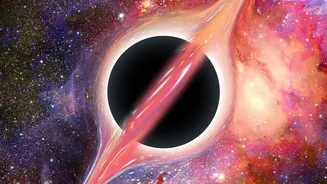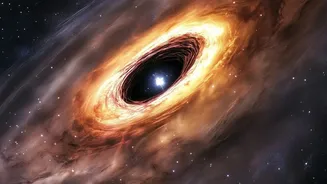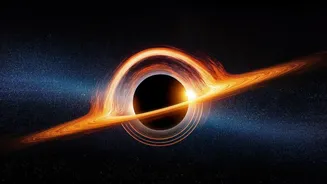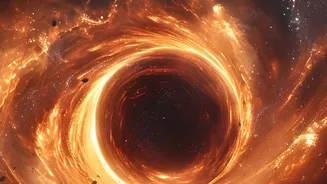





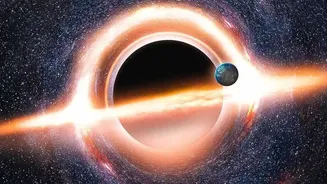
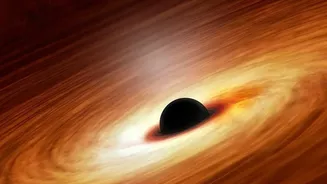
Black holes are famous for pulling things together, not breaking apart. But a new theoretical study is challenging that notion, suggesting that under the most extreme conditions, these cosmic behemoths might do the unthinkable: split in two.
The Universe's Ultimate Rule-Breakers?
We're used
to hearing about black holes merging. When two of these gravitational monsters collide, they create an even more massive black hole, sending ripples called gravitational waves through the fabric of spacetime. For decades, scientists have assumed this was a one-way street. The laws of physics, particularly a concept called entropy, seemed to forbid a black hole from splitting. Entropy is essentially a measure of disorder, and the universe strongly favours processes that increase it. For a stationary black hole, splitting into two smaller pieces would decrease entropy, making the event almost impossible under normal circumstances. This principle, linked to Stephen Hawking's area theorem, states that the total surface area of a black hole's event horizon—its point of no return—cannot shrink.
A High-Speed Loophole
However, new research published in the journal Physical Review D explores a potential loophole: extreme rotation. A team of physicists investigated what might happen if a black hole spins at or near its maximum possible speed. They found that the physics changes dramatically. A rapidly spinning black hole has a different relationship between its mass, angular momentum, and entropy. The immense rotational energy could, in theory, provide the necessary conditions to overcome the entropy barrier that normally prevents a split. The idea is that the black hole’s spin could be converted into the orbital momentum needed for the two new, smaller black holes to fly apart.
The 'Pair-of-Pants' Problem
For a split to be successful, two things must happen. First, the black hole's event horizon has to deform and divide. The researchers have dubbed this a 'pair-of-pants topology'. Imagine the event horizon's journey through time as a tube; in a split, that tube would divide into two separate 'legs', like a pair of trousers. But there's a second, crucial catch. Even if the black hole splits, the two resulting fragments must have enough energy to escape each other's immense gravity and not immediately fall back together and merge. According to the study's authors, this escape is only possible if the original black hole was spinning at, or very close to, its absolute maximum rate. This requirement makes the window for such an event incredibly narrow.
From Theory to Observation
It is important to stress that this remains a purely theoretical possibility. Astronomers have not observed a black hole splitting, and the conditions required are so extreme that it's unclear if they exist in nature. The study does not prove that splits happen, but rather that they are not entirely ruled out by our current understanding of physics. The researchers suggest that the phenomenon might be more likely for smaller, primordial black holes that may have formed in the early universe. According to Francesco Sannino, one of the study's co-authors, it might be possible to indirectly detect such an event. He suggests that gamma-ray telescopes could search for signals from tiny black hole fragments that might be created during these theoretical splits.