


More Tigers, A New Dilemma
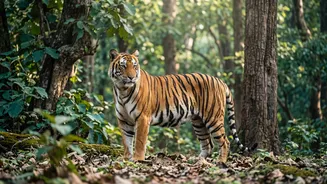
Thanks to decades of concerted efforts under Project Tiger, India's tiger count has seen a remarkable recovery, growing from a low of around 1,411 in 2006 to over 3,600 today. This success story, however, masks a complex problem. As tiger numbers grow within
the protected confines of reserves like Corbett, Kanha, and Tadoba, these areas are reaching their carrying capacity. The result is that many of India's tiger populations are becoming like islands—thriving, but disconnected from each other. This isolation poses a significant long-term threat: a loss of genetic diversity. Without the ability to move between territories and breed, tiger populations become inbred, leading to reduced fertility, increased vulnerability to diseases, and a weaker gene pool that is less adaptable to environmental changes. Studies have shown that modern tigers have already lost a significant amount of the genetic variation that existed just a century ago.
The Science of Genetic Rescue
Conservation strategy has therefore shifted beyond just increasing numbers. The focus now is on maintaining the genetic health of the entire tiger population. This is where two key strategies come into play: creating wildlife corridors and active relocation. The National Tiger Conservation Authority (NTCA) has mapped dozens of critical corridors—strips of forest that connect different tiger reserves. These corridors allow tigers, especially young sub-adults, to naturally disperse, find new territories, and breed with unrelated individuals, facilitating natural gene flow. However, when these corridors are fragmented by highways, farms, or settlements, natural movement becomes impossible. In these cases, translocation becomes a vital tool. It involves physically moving tigers from a high-density, genetically robust population to an area where the population is low, extinct, or genetically impoverished. This 'assisted migration' is a powerful method to mimic natural dispersal and inject new genetic material into isolated groups.
How to Move a Tiger
Relocating a tiger is a highly scientific and logistically complex operation. It begins with selecting the right animal from a source population, often a young, healthy individual. The chosen tiger is tranquilised, medically examined, and fitted with a radio collar for post-release monitoring. The animal is then transported, sometimes over hundreds of kilometres, to its new home. Upon arrival, it might be kept in a large, fenced enclosure for a period of 'soft release'. This allows the tiger to acclimatise to its new environment before being fully released into the wild. The entire process is a collaborative effort involving the NTCA, the Wildlife Institute of India, and state forest departments. Success stories from reserves like Sariska in Rajasthan and Panna in Madhya Pradesh, where tigers were locally extinct, prove the effectiveness of this method. Both reserves now have thriving, breeding tiger populations thanks to successful reintroduction programs.
The Human Element
Creating inviolate spaces for tigers often involves the most sensitive and challenging aspect of conservation: the voluntary relocation of human settlements from core forest areas. Many tiger reserves have villages within their boundaries, leading to human-wildlife conflict and resource competition. To create undisturbed habitats essential for tigers, the government offers compensation packages to encourage families to move outside the reserve. These packages typically include financial payment or a combination of land and housing at a new site, along with access to amenities like roads, electricity, and schools. While the goal is a win-win situation—safer lives and better opportunities for people, and secure habitats for wildlife—the process is fraught with challenges. Ensuring the relocation is truly voluntary and that the rehabilitated communities thrive in their new homes is a complex, long-term commitment that requires continuous engagement and support from authorities.
The Future of the Tiger
India's approach to tiger conservation has become a global model, evolving from simply protecting a species to actively managing its genetic future. Projects are underway across the country, from strengthening the population in Rajaji in Uttarakhand to addressing unique genetic issues in Odisha's Similipal, where a rare gene causes some tigers to have unusually dark stripes. Each mission provides valuable lessons. While the successes in Sariska and Panna are celebrated, failures, such as an early attempt in Satkosia, highlight the importance of community support and securing the habitat before animals are moved. The strategy is clear: for India's national animal to have a secure long-term future, it’s not enough for them to just survive in isolated pockets. They must be connected.