


The Constant Challenge: Earth’s Rotation
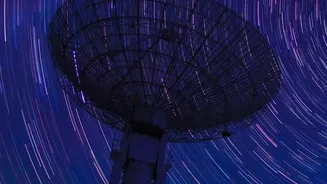
The single biggest obstacle in photographing faint, distant objects is that our planet never stops moving. The Earth rotates on its axis, which makes the stars appear to slowly drift across the night sky. While this motion is too slow for our eyes to notice
in real-time, a camera taking a long exposure will see it clearly. To capture the faint light from a galaxy millions of light-years away, photographers need to leave their camera's shutter open for minutes at a time. Without a way to counteract Earth's spin, even a few seconds of exposure is enough to turn pinpoint stars into blurry streaks.
A Simple Approach: The Alt-Azimuth Mount
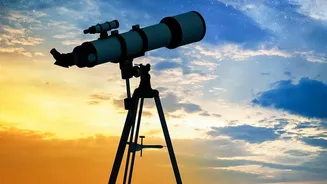
The most intuitive type of telescope mount is the alt-azimuth (or alt-az) mount. It moves in two simple directions: up and down (altitude) and left and right (azimuth). Think of it like the base of a camera tripod. For visual astronomy—just looking through an eyepiece—they are fantastic because they are simple, lightweight, and easy to use. Computerized 'GoTo' alt-az mounts can even find and track objects for you. The mount makes thousands of tiny up-down and left-right adjustments to keep the object in the center of the view. For looking at the Moon or planets, or even taking very short videos of them, this works reasonably well. But for long-exposure deep-sky imaging, this simple movement creates a fatal problem.
The Hidden Flaw: Field Rotation
The issue with an alt-az mount's tracking is called 'field rotation'. Because the mount is tracking in a series of straight up/down and left/right steps, it doesn't account for the fact that celestial objects appear to arc across the sky. While the mount keeps your target centered, the field of view around it slowly rotates. Imagine tracking a constellation as it rises, crosses the sky, and sets; its orientation to the horizon changes throughout the night. An alt-az mount keeps the target centered but doesn't correct for this twisting motion. In a long-exposure photograph, this means the central star might be sharp, but every other star in the frame will appear to rotate around it, creating small, curved trails. This effect makes it impossible to take the clean, multi-minute exposures needed for deep-sky objects.
The Elegant Solution: The Equatorial Mount
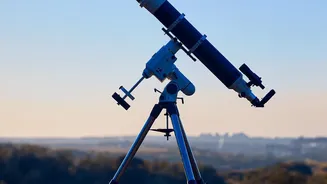
This is where the equatorial mount (EQ mount) proves its worth. Instead of moving parallel to the horizon, an EQ mount is designed to be tilted so that one of its axes, the Right Ascension (RA) or polar axis, is aligned with the Earth's own axis of rotation. In the Northern Hemisphere, this means pointing it directly at Polaris, the North Star. This process is called polar alignment. Once aligned, the mount only needs to rotate on this single axis, at the same speed as the Earth but in the opposite direction, to perfectly track any object in the sky. The second axis, Declination (Dec), is used only to point to the object initially and for minor guiding corrections.
Why It Is The Foundation of Great Images
By moving in a single arc that mirrors the sky's own movement, a properly aligned equatorial mount completely eliminates field rotation. This allows an astrophotographer to take exposures lasting many minutes, or even hours when combining multiple shots, without any rotational blurring. It keeps the entire field of view perfectly still. This is why many experienced imagers argue that the mount is the single most important piece of equipment you can buy. You can put the most expensive telescope and camera on a poor mount and get bad images, but a modest telescope on a solid equatorial mount can produce breathtaking results. The mount is the stable foundation upon which everything else is built.