


Shilpa Shetty consistently turns simple fitness tools into sources of major motivation. Her latest challenge involves an ordinary exercise ball, proving once again that you don't need a fancy gym to build serious strength, balance, and focus.
The Challenge: More Than Just Crunches
While the
headline mentions a single ball, Shilpa Shetty's recent fitness posts have showcased her using balls in varied and creative ways to challenge the body and mind. One notable routine involved not a large stability ball for crunches, but smaller balls for a coordination and balance drill. In a video, she demonstrates a 'brain gym' exercise, standing first on two feet and then on one, while dropping and catching two balls in a criss-cross pattern. This tests hand-eye coordination, focus, and stability. Another powerful move often seen in her routines and a staple for core work is the stability ball knee tuck. This exercise involves holding a plank position with your hands on the floor and your shins resting on a large exercise ball. From there, you use your core to pull your knees towards your chest, rolling the ball forward, before extending back to the starting plank position.
Why Use an Exercise Ball?
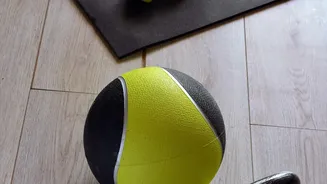
An exercise ball, also known as a stability or Swiss ball, is a versatile and effective piece of equipment. Its primary benefit comes from the instability it creates. When you perform an exercise like a knee tuck or even a simple plank on a ball, your body has to constantly work to maintain balance. This forces the engagement of deep core muscles, including your abdominals, lower back, and hips, which act as your body's foundation. Strengthening these muscles is crucial for better posture, preventing lower back pain, and improving overall stability in almost every activity you do. Beyond core strength, using a ball can expand your range of motion, improve flexibility through stretching, and enhance the mind-body connection by demanding focus and control.
How to Master the Stability Ball Knee Tuck
Ready to try the core-crushing knee tuck? Proper form is key to maximizing benefits and preventing injury. Start by getting into a high plank position with your hands directly under your shoulders. Carefully place the tops of your shins on the stability ball. Your body should form a straight line from your head to your heels. Before you move, brace your core as if you're about to be punched in the stomach. Slowly bend your knees, pulling them towards your chest and allowing the ball to roll forward with you. Keep your hips down and avoid letting your back sag. Pause for a moment in the tucked position, then slowly extend your legs to roll the ball back to the starting plank. The entire movement should be slow and controlled, focusing on using your abs, not momentum.
Shilpa's Philosophy: Fitness as Fun
This challenge is a perfect example of Shilpa Shetty's broader approach to wellness. She consistently finds ways to make her workouts engaging and fun, proving that fitness doesn't have to be a monotonous chore. Her social media is filled with varied routines, from high-intensity training and yoga to these playful coordination drills. She emphasizes that combining physical movement with cognitive training—like the focus required for her ball-catching drill—activates different parts of the brain, improves mental clarity, and strengthens neural connections. By sharing these unique exercises, she encourages her followers to think beyond conventional workouts and find activities that challenge both their body and their mind, making fitness a holistic practice.
Is This Challenge Right for You?
While Shilpa makes it look effortless, exercises like stability ball knee tucks are best suited for those with some baseline core strength. If you're a beginner, it's wise to master a standard floor plank first. You can start by simply holding a plank on the ball without any movement to get used to the instability. For the coordination drills, start slowly with just one ball before trying two. Listen to your body and work in an open space to avoid injury. The key is to progress gradually. As Shilpa's challenge reminds us, consistency and proper form are more important than attempting a complex move you're not ready for. The goal is to build a sustainable fitness habit that keeps you feeling strong and engaged.