

The Martian Garden Project
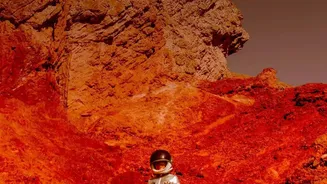
Across the globe, students are getting their hands dirty with simulated Martian soil, and their findings are crucial. From Villanova University's "Red Thumbs Mars Garden Project" to recent award-winning concepts by Texas students, these projects aim to answer
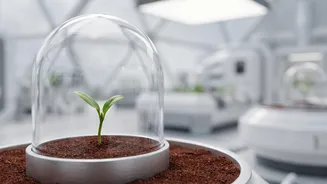
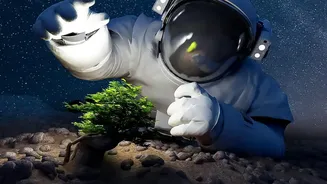
a simple question: can we farm on Mars? These experiments typically use what's called a regolith simulant—a material created to mimic the mineral composition of Mars's surface. Students plant various crops like lettuce, peas, and sweet potatoes to see what, if anything, will grow. While some projects have seen limited success with certain hardy greens, they consistently run into the same fundamental problems that even NASA is grappling with.
The Problem with Martian 'Soil'
The single biggest obstacle revealed by these experiments is the toxicity of the Martian regolith. Unlike Earth's soil, which is rich with organic matter and microbial life, Martian regolith is essentially crushed rock dust. Worse, it's laced with a high concentration of perchlorate salts. Experiments show that at the levels found on Mars, these salts are toxic to plants, often preventing seeds from even germinating. Even when plants do manage to sprout in simulants with lower perchlorate levels, their growth is severely stunted. This toxic salt is a dealbreaker; before any farming can begin, the perchlorates must be removed, a significant challenge in itself.
More Than Just Dirt and Water
Even if the soil toxicity is solved, other Martian conditions pose huge threats. Mars receives less than half the sunlight of Earth, and its thin atmosphere offers little protection from harsh solar and cosmic radiation. Furthermore, the atmosphere is about 95% carbon dioxide and lacks the nitrogen essential for plant growth. Student experiments often have to be conducted in carefully controlled greenhouses that simulate Martian light levels, but on Mars itself, any greenhouse would need to be heavily shielded from radiation and pressurized. The regolith also lacks the beneficial microbes that on Earth help plants access nutrients. This means future Martian farmers can't just plant a seed; they'll need to create an entire Earth-like ecosystem from scratch.
Finding a Workaround
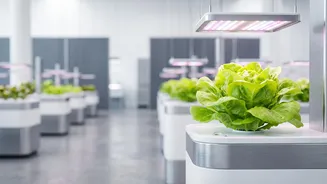
The challenges highlighted by student projects are precisely what space agencies are working to solve. The consensus is that using raw Martian regolith is not an option. One proposed solution is to "wash" the soil to remove the soluble perchlorates. Another promising avenue involves using specialized bacteria that can actually feed on perchlorates, breaking them down into harmless chlorides and releasing oxygen as a byproduct. Other approaches bypass soil altogether, focusing on hydroponic or aquaponic systems. A University of Greenwich project is exploring using fish waste to provide nutrients for crops grown in the regolith, effectively building a living soil from the ground up. These high-tech solutions show that while growing food on Mars is incredibly difficult, it may not be impossible.