



What Is This ‘Rare’ Alignment?
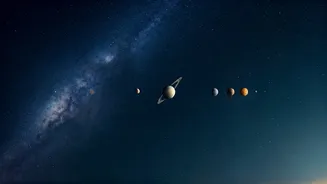
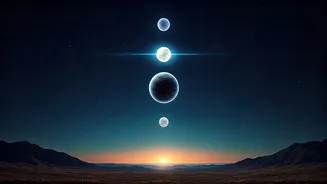
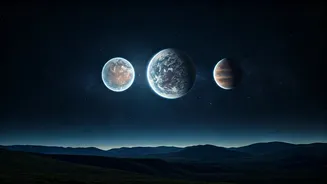
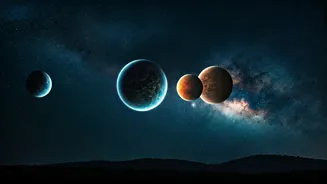
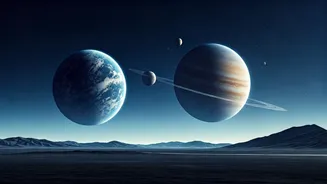
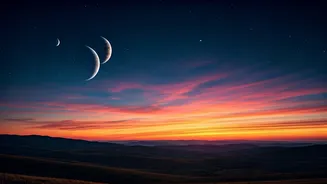
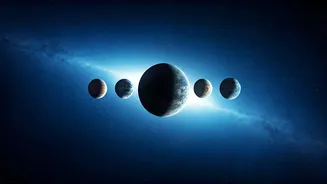
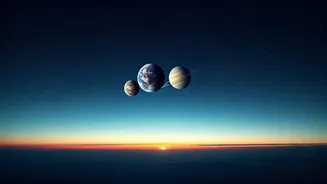
A planetary alignment, sometimes called a “planet parade,” isn’t when planets form a perfectly straight line in space as seen from the sun. Rather, it’s an event where several planets appear in the same small sector of the sky from our vantage point on
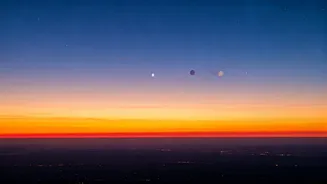
Earth. Think of it as a cosmic gathering rather than a rigid queue. While planets often appear near each other, having several bright ones clustered together within a few hours is what makes this a noteworthy event. The term 'rare' refers to the beauty of seeing multiple worlds—Mars, Jupiter, and Saturn—all in one glance during the morning twilight. This particular event around mid-June is part of a broader celestial dance that has been unfolding throughout the month, giving us a beautiful opportunity to connect with our solar system.
The Morning’s Main Attractions
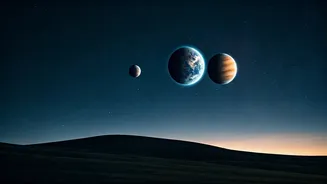
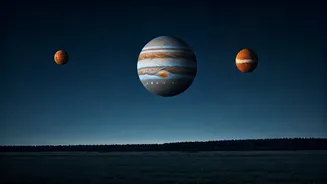
On and around June 17, three planets will be the stars of the show. You’ll be able to spot Saturn, Mars, and Jupiter without any special equipment. * **Saturn:** The ringed giant will be the first to rise. It will appear as a steady, yellowish-white point of light. While you won't see its famous rings with the naked eye, even a basic pair of binoculars might reveal it as a slightly elongated dot. * **Mars:** Following Saturn, the Red Planet will make its entrance. True to its name, Mars will have a distinct, faint reddish-orange hue, which sets it apart from the surrounding stars. * **Jupiter:** The king of the planets will be the last and brightest of the trio to rise before the sun. It will be unmistakably brilliant, shining with a powerful, silvery light low on the eastern horizon. Technically, Uranus and Neptune are also in the vicinity, but they are far too faint to be seen without a powerful telescope and a very dark sky.
Your Viewing Window: When to Look
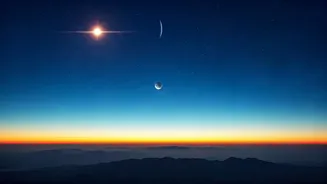
Timing is everything. This is a pre-dawn event, so you’ll need to be an early bird. The best viewing window is between 4:00 AM and 5:30 AM local time. You should start looking towards the eastern horizon from about 4:00 AM onwards. Saturn will be higher in the sky, with Mars below it, and Jupiter rising just before the morning twilight becomes too bright. The sky needs to be dark enough to see the planets but not so dark that they are below the horizon. As the sun begins to rise, the fainter planets will disappear into the glare first, with bright Jupiter being the last to fade.
Finding the Perfect Spot
You don't need to travel to a remote observatory, but your location does matter. The key is to find a spot with a clear, unobstructed view of the eastern horizon. Rooftops, balconies facing east, open fields, or parks away from tall buildings are ideal. The biggest challenge in urban areas is light pollution. While these planets are bright enough to cut through some city haze, the experience will be far more immersive if you can get to a location with darker skies. Use a simple compass app on your phone to get your bearings and find East before you head out.
Eyes, Binoculars, or a Telescope?
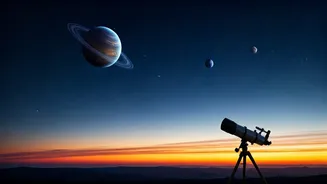
The beauty of this alignment is its accessibility. You can enjoy the basic spectacle with just your naked eyes. The three main planets are bright enough to be easily identified. However, if you have a pair of binoculars, bring them! Binoculars will not only make the planets appear brighter and larger but will also reveal Jupiter's four largest moons—Io, Europa, Ganymede, and Callisto—as tiny pinpricks of light huddled close to the planet. If you have a small telescope, you’ll be able to get a clearer view of Mars’s reddish colour and might even get a hint of Saturn’s magnificent rings.
How to Capture the Moment
Want to photograph the alignment? Even a smartphone can get a decent shot with a bit of preparation. First, a small tripod is essential to keep your phone steady for a long-exposure shot. Most modern smartphones have a 'Pro' or 'Night Mode' in their camera app. Switch to this mode and manually set the ISO to a lower number (like 400-800) to reduce noise, and the shutter speed to a few seconds (try 5-10 seconds). Use the self-timer feature to avoid camera shake when you press the shutter button. Don't expect a Hubble-quality image, but you can capture the essence of the planetary gathering and have a beautiful memento of your morning with the cosmos.