





What Creates the Turquoise Seas?
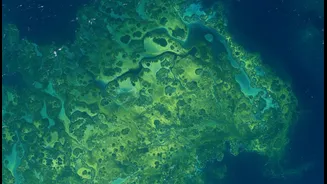
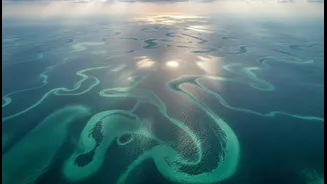
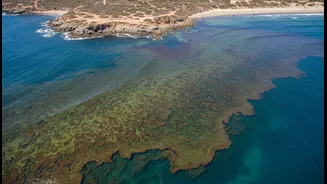
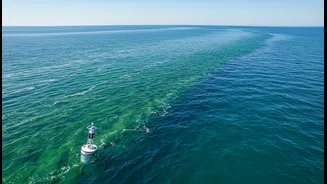
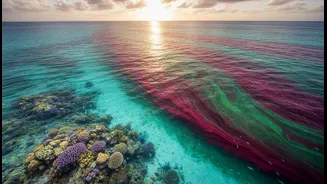
The ethereal colour is caused by massive blooms of a specific type of phytoplankton called coccolithophores. These single-celled organisms are encased in tiny, intricate plates made of calcium carbonate, the same compound that forms chalk and seashells.
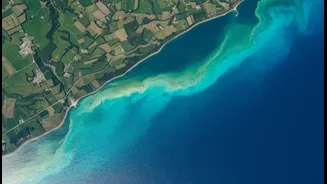
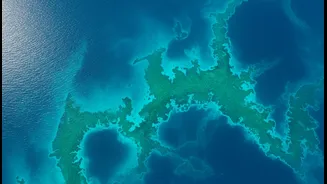
When conditions are right—often in calmer, nutrient-variable waters—their populations explode. The organisms shed their calcium carbonate plates, called coccoliths, into the water. It is the sheer volume of these highly reflective plates suspended in the upper ocean that scatters sunlight, transforming the water's appearance into a distinctive turquoise that is easily visible to satellites hundreds of kilometres above Earth.
The View from Orbit
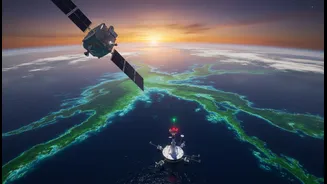
Scientists use ocean-colour satellite imagery to detect and monitor these blooms, which can cover hundreds of thousands of square kilometres. Instruments like NASA's Moderate Resolution Imaging Spectroradiometer (MODIS) can identify the unique spectral signature of these blooms, distinguishing the light scattered by coccoliths from other particles like sediment. For decades, this satellite data has allowed researchers to build a global picture of where and when these blooms occur, from the North Atlantic to the Southern Ocean. A recent NASA mission, PACE (Plankton, Aerosol, Cloud, ocean Ecosystem), is providing even more detailed insights, helping to distinguish between different types of phytoplankton on a global scale for the first time.
A Barometer for Ocean Nutrients
Coccolithophore blooms are more than just a beautiful phenomenon; they are a critical indicator of marine nutrient cycles. Phytoplankton, the foundation of the marine food web, rely on nutrients like nitrates, phosphates, and silicates to grow. Different types of phytoplankton thrive under different nutrient conditions. Diatoms, another major group, tend to dominate in nutrient-rich waters. Coccolithophores, however, have a competitive advantage in waters where other nutrients might be less plentiful. Therefore, a shift towards more frequent or larger coccolithophore blooms in a particular region can signal a fundamental change in the local nutrient availability.
Reading the Shifting Tides of Change
Recent research suggests that human-driven climate change is beginning to overhaul these crucial nutrient cycles. As the ocean surface warms, it becomes more stratified, acting like a lid that prevents the upwelling of nutrient-rich deep water to the surface. Studies analyzing decades of ocean data have found evidence of these shifts, such as a decline in phosphorus in the southern hemisphere's oceans. The changing availability of nutrients like nitrogen and phosphorus can alter the composition of phytoplankton communities, favouring organisms like coccolithophores in some areas while disadvantaging others. Observing the distribution of these turquoise blooms from space gives scientists a large-scale tool to track these invisible, but profound, chemical changes happening in our oceans.
Why This Matters for India's Coasts
For a nation with a 7,500-kilometre coastline, understanding marine health is paramount. The composition of phytoplankton at the base of the food web directly impacts fisheries, a vital source of food and livelihood for millions in India. Changes in nutrient cycles, as indicated by blooms, can have cascading effects up the food chain. For instance, research in the Arabian Sea has linked melting Himalayan snowcaps to intensified monsoon activity, which in turn enhances the upwelling of nutrients and affects phytoplankton growth. While some blooms are a natural part of the ecosystem, major shifts can disrupt the balance, sometimes leading to less nutritious food sources for fish or even harmful algal blooms. Monitoring these vast turquoise patches from above is therefore a key part of understanding the health of our marine resources and predicting how they will respond to a changing climate.