





The Myth: A Magnifying Glass in the Sky
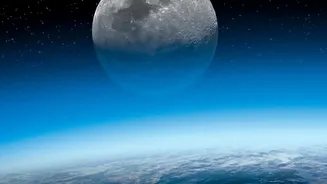
The most popular theory for the Moon illusion, which dates back to antiquity, is that the atmosphere magnifies it. The idea is that when the Moon is low on the horizon, its light travels through a much thicker slice of air, which acts like a giant lens
and makes it look bigger. It sounds plausible, and even the ancient Greek philosopher Aristotle considered it. However, this explanation is definitively false. If the atmosphere were acting as a magnifying lens, this effect would be measurable. But when photographers take pictures of the horizon moon and then the same moon high in the sky hours later using the same camera settings, the moon's size in the photos is identical. In fact, atmospheric refraction does the opposite: it slightly squashes the moon vertically, making it look a tiny bit smaller and more oval, not larger. The dramatic color change to orange or red is a real atmospheric effect caused by light scattering, but the size change is not.
The Reality: It’s All In Your Head
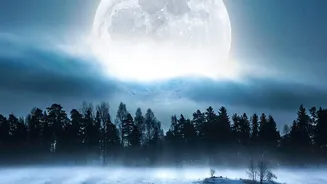
The Moon illusion is not a physical or atmospheric phenomenon; it is a psychological one. The entire spectacle is an optical illusion created by your brain as it tries to make sense of the world. Though scientists have studied it for centuries, there isn't one single, universally agreed-upon explanation. However, the leading theories all center on how our brains process context, depth, and size. When the Moon is high in the sky, it's a lone object in a vast, empty expanse. With no other visual cues for comparison, your brain perceives it as a small, distant object. But when it’s on the horizon, the game completely changes.
The Leading Theory: Apparent Distance and Ponzo's Trick
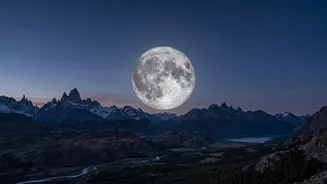
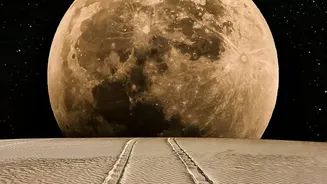
The most widely accepted explanation is the 'apparent distance' hypothesis, often illustrated with the Ponzo illusion. Imagine two identical lines drawn on a picture of railroad tracks converging in the distance. The line drawn where the tracks are 'farther' away will appear larger, even though it's the same size as the 'closer' one. Your brain automatically compensates for perceived distance, telling you that if two objects cast the same size image on your retina, the one that appears farther away must be physically larger. The horizon moon is your brain’s railroad track illusion. The landscape—trees, buildings, mountains—provides a rich set of depth cues that tells your brain the horizon is very far away. When the moon appears in this context, your brain perceives it as being at that same great distance and scales up its size accordingly. The overhead moon, lacking these terrestrial reference points, is perceived as being closer, and therefore your brain sees it as smaller.
How to Break the Illusion Yourself
Because the Moon illusion is a trick of the mind, you can perform simple experiments to break it. One of the easiest ways is to remove the surrounding context. When the Moon looks huge on the horizon, try looking at it through a cardboard tube or a piece of paper rolled into a narrow pipe. By blocking out the foreground and horizon, you isolate the Moon from the depth cues that trick your brain, and it will immediately appear to shrink back to its normal size. Another classic trick is to bend over and look at the moon upside down between your legs. This disorientation disrupts your brain’s normal scene-processing rules, and the illusion vanishes. You can also simply hold a small object, like a pea or a pencil eraser, at arm’s length and compare it to the size of the horizon moon. You'll find it covers the same amount of the moon whether it's on the horizon or high in the sky, proving its apparent size never changed.