




A New Shape in the Clouds
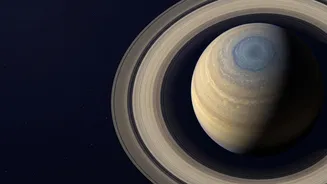
For decades, scientists have been captivated by a massive, six-sided jet stream—a hexagon—swirling around Saturn’s north pole. It was considered a one-of-a-kind oddity in the solar system. Now, that’s all changed. Recent analysis of images from the Hubble
Space Telescope has revealed a southern counterpart: a giant, ten-sided wave, or decagon, encircling the planet’s south pole. The discovery, published in the journal Science Advances, was made by an international team of astronomers who noticed the pattern developing in images captured since 2023. This isn't a solid structure, but a massive wave within a powerful jet stream, with each of its ten sides estimated to be over 16,000 kilometers long. It is the first large, regular-sided jet pattern ever observed in Saturn's southern hemisphere.
A Tale of Two Poles
The northern hexagon has been a stable fixture for over 40 years, a deep-rooted structure extending high into the atmosphere. Scientists had long searched for a similar feature at the south pole without success. NASA's Cassini spacecraft, which orbited Saturn from 2004 to 2017, saw a polar vortex but no persistent polygon. This new decagon appears to be a recent development. Unlike the seemingly rigid northern hexagon, the southern decagon is more dynamic. Its discovery was possible thanks to Saturn's changing seasons; the planet's axial tilt has only recently brought the south pole back into clear view from Earth after it was hidden for years.
How Was It Hidden?
The decagon wasn't just hidden by Saturn's tilt, but also by its own nature. It’s an atmospheric wave that extends vertically through multiple layers of haze. Astronomers uncovered it by observing Saturn through different color filters on the Hubble telescope. Each filter probes a different altitude in the atmosphere. Because the decagon's position appeared to shift slightly between these filtered images, scientists could deduce that it wasn't just a surface-level cloud pattern but a deep, three-dimensional structure. The first hints came from ground-based observatories, where amateur astronomers noted a subtle disturbance in 2024, prompting the team to use Hubble's superior resolution to confirm the stunning ten-sided shape.
The Science of Strange Shapes
So, what creates these planetary polygons? These shapes are believed to be standing waves that form within powerful, fast-moving jet streams. Just as wind blowing over a mountain can create a wave in the air, the complex fluid dynamics in Saturn's atmosphere can cause its jet streams to meander into a stable, geometric pattern. The northern hexagon has been successfully duplicated in lab experiments with spinning liquids, but the emergence of a decagon presents a new puzzle. One theory suggests the decagon may have been triggered by a nearby storm vortex that was observed darkening just before the ten-sided shape emerged. This new data point will provide a crucial test for computer models that simulate how planetary atmospheres work.
Why This Discovery Matters
The discovery of the southern decagon is significant because it proves Saturn's northern hexagon is not a complete anomaly. It suggests that such geometric patterns may be a more common, though perhaps transient, feature of gas giant atmospheres. We are potentially witnessing the birth of a new, large-scale atmospheric phenomenon. This finding underscores the dynamic and ever-changing nature of planets we once thought were timeless. It also highlights the importance of long-term monitoring projects like Hubble's Outer Planet Atmospheres Legacy (OPAL) program, which allow scientists to track changes over many years.