






The Challenge: A Data Tsunami from Orbit
For decades, the model for space-based observation has been straightforward: a satellite captures vast amounts of data—images, sensor readings, and more—and beams it all back to Earth. Ground stations then receive this massive data dump, which requires
powerful computers and significant time to process and analyse. This process creates a major bottleneck. The sheer volume of information can overwhelm communication bandwidth, leading to delays in getting actionable insights. In situations like disaster management or military surveillance, where speed is critical, this lag can render valuable information obsolete by the time it's ready. Imagine a satellite capturing images of a flooded region; by the time terabytes of data are sent to Earth and analysed to identify stranded individuals, the window for a successful rescue may have already closed.
The Solution: An AI Brain in the Sky
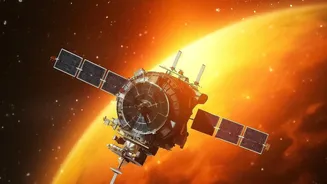
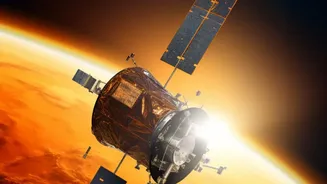
The next evolution in satellite technology is to move the 'thinking' from the ground into orbit itself. This is where artificial intelligence comes in. Instead of transmitting raw, unfiltered data, an AI-powered satellite can process information on board. This concept, known as edge computing, allows the satellite to analyse images and sensor readings in real-time, decide what's important, and send back only the refined analysis or critical alerts. For example, rather than sending thousands of high-resolution images of a forest, the satellite's AI can be tasked to simply alert ground control if it detects the heat signature of a wildfire. This reduces the amount of data transmitted by orders of magnitude, freeing up bandwidth and enabling near-instantaneous decision-making.
India's Leap: The MOI-1A Mission
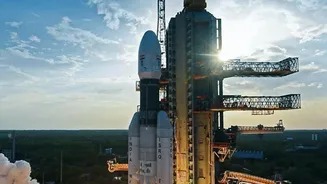
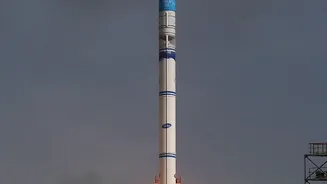
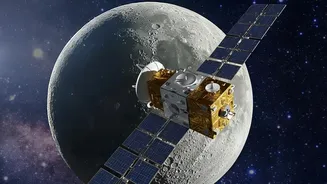
Hyderabad-based startup TakeMe2Space is launching India's first orbital computing satellite, MOI-1A, scheduled to fly on October 1, 2026, aboard a SpaceX Falcon 9 rocket. This compact satellite, weighing less than 50 kg, is essentially a small data centre in space, equipped with powerful Nvidia Orin NX chips designed for edge computing. Its primary mission is to prove that AI models can effectively process Earth-observation data in orbit before transmission. What makes MOI-1A particularly innovative is its architecture. It allows customers—of which there are already 23, from sectors like agriculture, mining, and insurance—to upload their own custom AI models directly to the orbiting satellite. This means a company monitoring crops can run its unique algorithm to predict yields, while an insurer can assess infrastructure risk using its own proprietary model, all processed in space.
Lessons for the Final Frontier
The success of missions like MOI-1A holds profound lessons for the future of all space exploration. The most immediate benefit is efficiency and speed. For Earth observation, it means faster disaster alerts, more efficient resource management, and real-time intelligence gathering. But the implications extend far beyond our planet. For deep-space missions, such as journeys to Mars or the outer planets, communication delays can be as long as 20 minutes each way. In such scenarios, real-time control from Earth is impossible. An autonomous spacecraft must be able to make its own decisions, from navigating asteroid fields to identifying scientifically interesting targets for analysis. Onboard AI is the key to this autonomy. It allows a rover or probe to diagnose its own faults, perform corrective actions, and manage its mission objectives without constant human intervention. India's work in this area, including the AI used in the Chandrayaan missions, is building a crucial foundation for these future autonomous systems.