

A Celestial Alignment
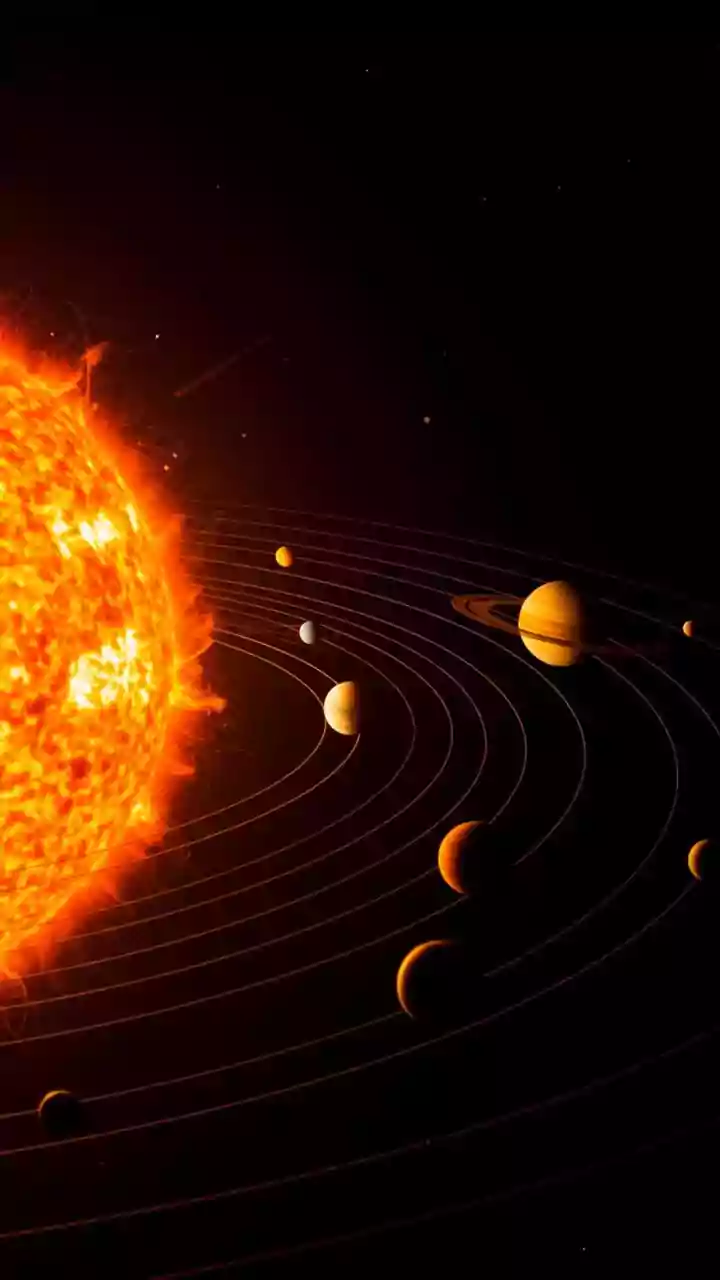
A lunar eclipse occurs when the Sun, Earth, and Moon align perfectly, in that specific order. During this alignment, which only happens during a full moon, the Earth passes directly between the Sun and Moon, casting its massive shadow onto the lunar surface.
This cosmic shadow play is what we see as an eclipse. However, we don't get an eclipse every full moon because the Moon's orbit around Earth is tilted by about five degrees relative to Earth's orbit around the Sun. Most of the time, the full moon passes just above or below Earth's shadow. Only when the full moon crosses the Earth's orbital plane at the right time does it pass through the shadow, creating an eclipse.
It’s All About The Shadow
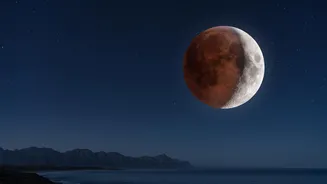
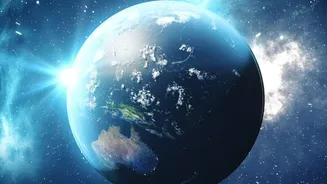
The primary reason for the wide visibility of a lunar eclipse comes down to a simple matter of size. The Earth is much larger than the Moon, and as a result, it casts a very large shadow. This shadow has two parts: a faint, outer shadow called the penumbra, and a dark, inner shadow called the umbra. When the Moon passes into the umbra, it is completely blocked from direct sunlight. Because the Earth's umbra is so much wider than the Moon itself, the entire Moon can be engulfed by it for a significant period. Anyone on the night side of Earth, where the Moon is above the horizon, can look up and see the event unfold. It's like a cinema screen where the movie is visible to everyone in the theatre at the same time.
The Solar Eclipse Contrast
To truly appreciate this, it helps to compare it with a solar eclipse. During a solar eclipse, the much smaller Moon passes between the Sun and Earth, casting its shadow on our planet. Because the Moon is so much smaller, its shadow is also much smaller, creating only a narrow path of totality across Earth's surface, often just a couple of hundred kilometres wide. To see a total solar eclipse, you must be located within this very specific, fast-moving path. It’s a rare and localized event for any given spot on Earth. A lunar eclipse, by contrast, puts the vast shadow of our own planet on display, making it a far more accessible spectacle for a global audience.
A Slow and Lasting Show
Another factor contributing to the wide visibility is the duration of the event. A total lunar eclipse is a leisurely affair. The entire process, from the moment the Moon first enters the penumbra to when it finally leaves, can last for several hours. The period of totality, when the Moon is fully inside the dark umbra, can last for over an hour. This long duration means that as the Earth rotates on its axis, more regions are brought into the night side, giving more people a chance to witness at least part of the eclipse. Someone in the early evening might see the eclipse begin, while someone further west will see it at its peak in the middle of their night.
The 'Blood Moon' Bonus
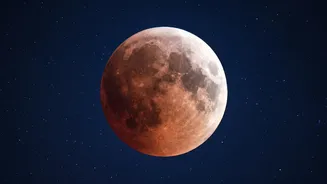
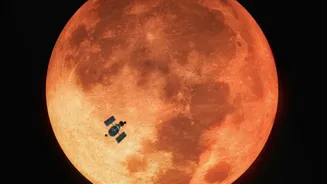
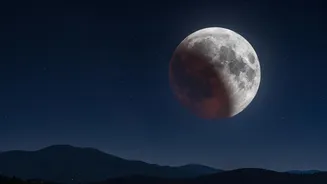
Even when the Moon is fully inside Earth's darkest shadow, it doesn't usually disappear completely. Instead, it often glows with a faint, reddish hue, earning it the nickname "Blood Moon." This happens because some sunlight still reaches the Moon, but it first has to pass through Earth's atmosphere. Our atmosphere scatters the shorter-wavelength blue and violet light but allows longer-wavelength red and orange light to pass through and get bent, or refracted, toward the Moon. In effect, the eclipsed Moon is being illuminated by the light of all of Earth's sunrises and sunsets at once. The exact colour can vary from coppery red to brownish depending on the amount of dust and clouds in Earth's atmosphere.