





The Great Monsoon Myth
One of the most persistent skincare myths during the rainy season is that cloudy skies mean you can safely skip sunscreen. This belief stems from a simple misunderstanding: we associate sun damage with visible sunlight and heat. However, the ultraviolet
(UV) radiation that harms our skin is invisible and not related to temperature. Even on the most overcast, rainy days, a significant amount of UV radiation penetrates the cloud cover, silently affecting your skin. This creates a false sense of security, leading to cumulative damage that might only become apparent months later as pigmentation and fine lines.
Understanding the Invisible Threat: UVA vs. UVB
To grasp why monsoon sun protection is crucial, it's important to know the difference between the two main types of UV rays that reach us: UVA and UVB. UVB rays are the primary cause of sunburn and are partially blocked by clouds. This is why you're less likely to get a painful burn on a cloudy day. UVA rays, however, have a longer wavelength that penetrates deeper into the skin. They are responsible for long-term damage like premature ageing, wrinkles, and collagen breakdown. Critically, UVA rays are present with consistent intensity all year round and can easily pass through clouds and even glass. They account for up to 95% of the UV radiation reaching the Earth's surface, making them a constant threat regardless of the season.
Why Clouds Don't Protect You
Scientific studies show that up to 80% of the sun's UV rays can pass through cloud cover. Clouds are far more effective at blocking visible light than they are at blocking UV radiation. In some situations, known as the "broken-cloud effect," scattered clouds can even reflect and scatter UV rays, increasing their intensity on the ground. Furthermore, wet surfaces like roads and buildings reflect UV radiation, adding to your overall exposure. This means that during a typical Indian monsoon day, your skin is still vulnerable to the damaging effects that lead to tanning, hyperpigmentation, and photoaging.
Monsoon-Specific Skin Concerns
The high humidity during the Indian monsoon brings its own set of challenges. Increased sweat and sebum production can make skin feel sticky and clog pores, leading to breakouts. This humid environment makes many people hesitant to apply another layer of product. Moreover, humidity, sweat, and rain can cause sunscreen to wear off more quickly, making reapplication essential. For Indian skin, which is often more prone to hyperpigmentation and tanning, consistent UVA exposure during the monsoon can worsen dark spots and create an uneven skin tone. Daily sunscreen use is a key step in preventing this cumulative damage and protecting the skin's barrier, which can be weakened by the constant shift between outdoor humidity and indoor air-conditioning.
Choosing Your Monsoon Armour
The key to consistent sunscreen use during the monsoon is finding a formula you'll enjoy wearing. Heavy, greasy creams can feel uncomfortable in humid weather. For the Indian climate, dermatologists often recommend lightweight, non-comedogenic (won't clog pores) formulas. Look for labels like "gel-based," "water-based," or "dry-touch" for a comfortable, matte finish. A broad-spectrum sunscreen with an SPF of 30 or higher is essential for protection against both UVA and UVB rays. For optimal protection against ageing and pigmentation, look for a high PA rating (like PA++++) which specifically indicates strong UVA defense.
Application and Reapplication Rules
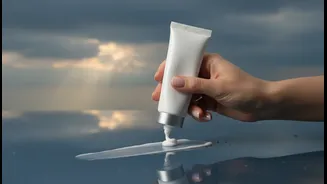
Even the best sunscreen is only effective if applied correctly. Use a generous amount for your face and neck—a common guideline is the "two-finger rule." Apply it as the last step of your skincare routine, before any makeup. Remember that SPF in your foundation or compact powder is not enough, as you would need to apply a very thick layer to get the stated protection. During the monsoon, reapplication is more important than ever. If you've been sweating or got caught in the rain, reapply your sunscreen. A water-resistant formula can provide more durable protection, but it's still wise to reapply every few hours if you're outdoors for an extended period.