



A Tale of Two Worlds
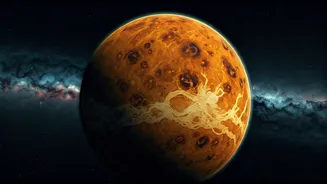
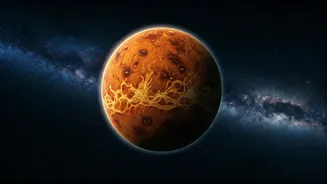
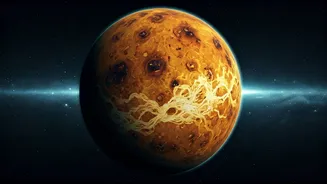
Venus is often called Earth’s twin, and for good reason. The two planets are strikingly similar in size, mass, density, and composition. They are neighbours in the inner solar system, born from the same cosmic materials. Yet, the resemblance ends there.
While Earth became a haven for life, Venus devolved into a vision of hell. Its atmosphere, over 90 times thicker than ours, is a toxic blend of carbon dioxide with clouds of sulphuric acid. The surface temperature is a staggering 475°C, hot enough to melt lead, making it the hottest planet in the solar system. This dramatic divergence is a central mystery in planetary science. Venus is a cautionary tale, a planet that may have once had oceans and a temperate climate before a runaway greenhouse effect took hold, boiling the water away and trapping heat permanently.
Enter Shukrayaan: India’s Next Great Leap
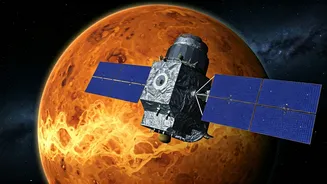
Following the triumphant successes of its missions to the Moon (Chandrayaan) and Mars (Mangalyaan), the Indian Space Research Organisation (ISRO) is setting its sights on this enigmatic neighbour. The Venus Orbiter Mission, named Shukrayaan-1 (from the Sanskrit for Venus, 'Shukra', and craft, 'Yaan'), is India's ambitious first mission to the second planet. Scheduled for a potential launch in March 2028 aboard a heavy-lift LVM-3 rocket, the mission marks a significant step in India’s interplanetary exploration programme. The spacecraft, with an expected mass of around 2,500 kg and carrying a 100 kg payload of scientific instruments, will be placed in a large elliptical orbit around Venus to begin its investigation. This mission places India in the elite club of nations turning their attention back to Venus, joining planned missions from NASA and the European Space Agency.
The Core Scientific Quest
So, what exactly does ISRO hope to find? The objectives for Shukrayaan-1 are broad and deeply consequential. A primary goal is to map the Venusian surface and, for the first time, its shallow sub-surface. Since thick clouds perpetually hide the planet's face, this will be done with powerful radar instruments capable of peering through the opaque atmosphere. ISRO aims to investigate geological processes, including active volcanic hotspots, lava flows, and the planet's stratigraphy—the layering of its rocks. Another key area of focus is the super-rotating, hostile atmosphere. The mission will study its composition, structure, and dynamics to better understand the runaway greenhouse effect. Finally, Shukrayaan-1 will investigate the interaction between the solar wind and the Venusian ionosphere, which is crucial for understanding how Venus lost its water and evolved so differently from Earth, as it lacks a protective global magnetic field.
A Toolkit for a Hostile World
To achieve these ambitious goals, Shukrayaan-1 will be equipped with a sophisticated suite of scientific instruments, both Indian and international. The centrepiece is a high-resolution Synthetic Aperture Radar (SAR), which can create detailed maps of the surface regardless of the cloud cover, day or night. It will also carry a ground-penetrating radar, a world-first for Venus, to explore what lies beneath the immediate surface. International collaboration is a key part of the mission. Payloads from Russia, Sweden, and Germany are expected to be on board, including instruments designed to analyse atmospheric gases and the interaction with solar wind particles. This suite of tools will give scientists a comprehensive view of Venus, from its deep geology to the top of its turbulent atmosphere.