


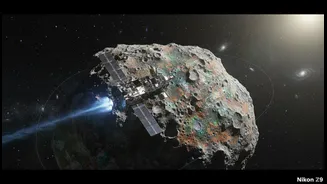


A New Chapter for a Legendary Probe
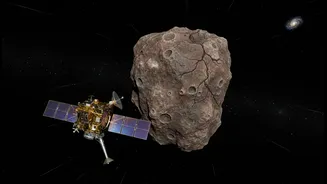
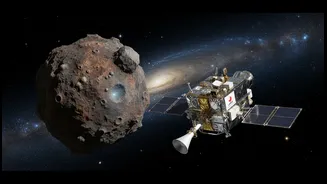
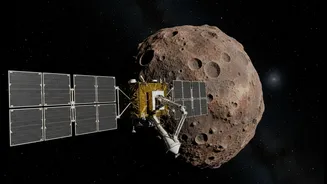
The Hayabusa2 mission, operated by the Japan Aerospace Exploration Agency (JAXA), already secured its place in history when it successfully returned samples from the carbon-rich asteroid Ryugu in December 2020. For most missions, this would be the grand
finale. But with a healthy spacecraft and about half of its xenon fuel remaining, JAXA sent the probe on an ambitious extended mission. This bonus journey is a testament to the probe's robust engineering and offers a chance for more discovery. Its first major objective was the high-speed flyby of a second asteroid, an encounter that happened on July 5, 2026, pushing the boundaries of what a sample-return mission can achieve.
Meet Torifune, the Snowman Asteroid
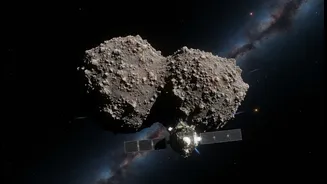
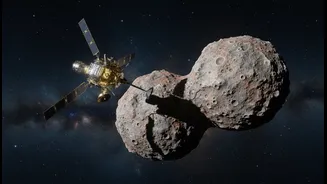
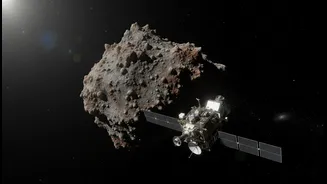
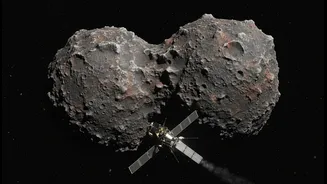
The new target is asteroid (98943) 2001 CC21, which was given the official name 'Torifune' following a public campaign. The name refers to a god and a ship in Japanese mythology known for travelling safely at high speed. Unlike the C-type (carbonaceous) Ryugu, Torifune is an S-type, or stony, asteroid. This makes it a scientifically valuable target for comparison, offering a look at a different class of celestial body. The most exciting discovery from the flyby is its shape. Images confirm that Torifune is a 'contact binary', resembling a snowman where two separate asteroids have gently fused together. Such objects provide crucial clues about how asteroids form and interact in the chaotic environment of space.
For the Space Reader: A Continuing Cosmic Saga
For those who follow the narratives of space exploration, this is a thrilling sequel. Hayabusa2 is a proven hero, a plucky explorer that overcame challenges at Ryugu and successfully delivered its precious cargo. Its extended mission is like a victory lap that is also packed with new drama. The flyby was not a leisurely stroll; the probe sped past Torifune at a relative velocity of about 5 kilometers per second. Capturing clear images and data at that speed is a remarkable feat of navigation and engineering, requiring precise last-minute adjustments. It is a story of human ingenuity, pushing a machine designed for one task to perform another, millions of kilometers from home.
For the Student: A Live Lesson from Deep Space
Missions like Hayabusa2 are a classroom in the cosmos. For students in India and around the globe, the Torifune flyby is a real-time application of physics, computer science, and engineering. It demonstrates the principles of orbital mechanics, the challenges of remote communication, and the thrill of scientific discovery. When JAXA releases new images and findings, it provides tangible, exciting material that can ignite a passion for STEM fields. It’s a powerful reminder that the complex equations in textbooks are used to achieve incredible things, like guiding a spacecraft to a precise rendezvous with a tiny, fast-moving rock, transforming abstract concepts into an inspiring reality.
For Planetary Science: A High-Speed Data Puzzle
For scientists, the Torifune flyby is a treasure trove of new data. Studying an S-type asteroid provides a critical counterpoint to the C-type asteroids Ryugu and Bennu, helping to build a more complete picture of our Solar System's early materials. Furthermore, the mission serves a vital purpose for planetary defense. Torifune is a near-Earth asteroid, and practicing high-speed, close-approach navigation techniques is crucial for developing the ability to intercept or deflect a potentially hazardous object in the future. The data will help scientists understand the structure and composition of these stony bodies, knowledge that would be essential if one were ever on a collision course with Earth. This flyby is not just about looking at the past; it is also about safeguarding our future.