




The Sun's Violent Outbursts
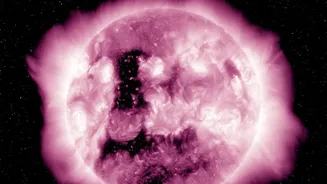
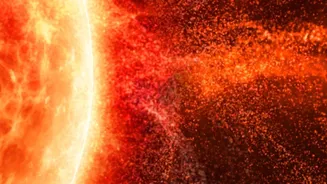
The “eruptive solar atmospheric events” mentioned in the headline are massive explosions from the Sun's atmosphere, known primarily as Coronal Mass Ejections (CMEs). These events involve the release of enormous clouds of plasma and magnetic fields from the Sun's outer
layer, the corona. A single CME can eject billions of tonnes of material, travelling at speeds from 250 to 3,000 kilometres per second. While many CMEs miss Earth entirely, those directed towards our planet can have significant consequences. Often associated with solar flares—intense bursts of radiation—these eruptions are a major component of what we call space weather. The frequency of these events varies with the Sun's 11-year cycle, with several CMEs per day possible during solar maximum.
The Challenge of Staring at the Sun
Studying these eruptions presents a fundamental problem: the Sun itself is blindingly bright. The corona, where CMEs originate, is millions of times fainter than the Sun's main disk. Under normal circumstances, the corona is completely washed out by the glare, making it invisible. The only time it is naturally visible from Earth is during a total solar eclipse, when the Moon perfectly blocks the Sun's bright face. While eclipses offer a breathtaking view, they are too rare, brief, and localised to serve as a reliable method for monitoring the Sun's constant activity. To effectively watch for dangerous CMEs, scientists needed to invent a way to create an artificial eclipse on demand.
Enter the Coronagraph: An Artificial Eclipse
A coronagraph is a specialised telescopic instrument designed to do exactly that: block the overwhelming light from a star to reveal the faint objects around it. Invented in the 1930s by Bernard Lyot, a coronagraph uses an occulting disk—a precisely engineered mask—to block the direct light from the Sun's surface. This allows the much dimmer corona to be observed and studied continuously. While ground-based coronagraphs exist, they are hampered by light scattering in Earth's atmosphere. For an uninterrupted, crystal-clear view, these instruments are best placed in space. Missions like the joint NASA-ESA Solar and Heliospheric Observatory (SOHO) have used space-based coronagraphs for decades, revolutionising our understanding of solar activity.
Why Monitoring is a Global Imperative
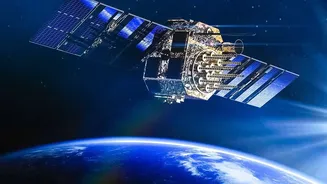
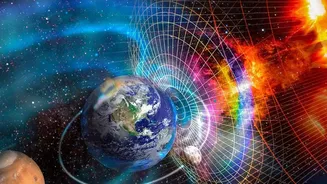
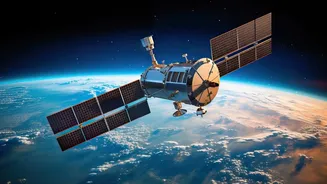
This isn't just an academic exercise. When a CME strikes Earth, it can trigger a geomagnetic storm by interacting with our planet's magnetic field. These storms can induce powerful currents in long conductors on the ground, such as power lines and pipelines. A severe storm could overwhelm electrical grids, leading to widespread and long-lasting blackouts, as happened in Quebec in 1989. Modern society is profoundly vulnerable. Satellites, which we rely on for communication, GPS navigation, and financial transactions, are at risk of being damaged by energetic particles. Airline travel, especially polar routes, can be disrupted, and astronauts in orbit face radiation hazards. By using coronagraphs to see CMEs as they leave the Sun, we get crucial lead time—from hours to days—to prepare.
India’s Eye on the Sun: Aditya-L1
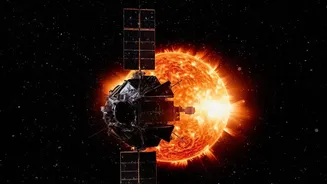
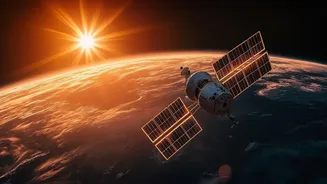
India has firmly established itself as a key player in this global effort with the Aditya-L1 mission. Launched by the Indian Space Research Organisation (ISRO), Aditya-L1 is India's first dedicated solar observatory. Positioned 1.5 million kilometres from Earth at the L1 Lagrange point, it has an unbroken view of the Sun. The heart of its remote-sensing capability is the Visible Emission Line Coronagraph (VELC). Developed by the Indian Institute of Astrophysics, VELC is designed to continuously study the solar corona, providing critical data on the initiation and dynamics of CMEs. This not only advances global scientific understanding but also enhances India's capability to forecast space weather and protect its own critical infrastructure and space assets.