




The Ice Giant’s Faint Jewellery
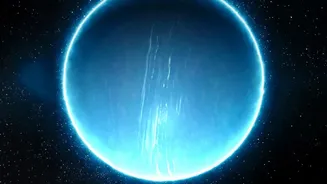
When we picture a ringed planet, Saturn’s magnificent, bright system immediately comes to mind. But it is not the only planet with this feature. The ice giant Uranus has 13 known rings, which are so faint and dark they were only discovered in 1977. Unlike
Saturn's rings, which are made of highly reflective water ice, Uranus's rings are composed of material that is darker than charcoal. They reflect less than 5% of the sunlight that hits them, making them some of the darkest objects in our solar system and incredibly difficult to study from Earth. This stark difference has long been one of the great puzzles of the outer solar system.
A Puzzle of Composition
The darkness of the rings has puzzled astronomers since they were first observed. Early theories struggled to explain what material could be so non-reflective. Data from the Voyager 2 spacecraft's flyby in 1986 confirmed their low albedo (reflectivity) but didn't solve the core mystery. The leading hypothesis has long been that the rings are not made of pure ice. Instead, they are thought to be a mixture of ice and some other dark material. The key question has always been: what is this dark material, and where did it come from?
The Carbon Clue
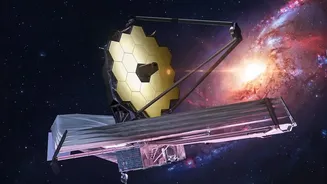
Recent analysis and new observations, including stunning images from the James Webb Space Telescope, are finally providing answers. The prevailing theory is that the rings are composed of or coated with dark, carbon-rich organic compounds. This material is likely the result of radiation processing. Over millions of years, charged particles from Uranus's magnetosphere have bombarded the surfaces of the ring particles, breaking down molecules like methane ice and leaving behind a dark, carbonaceous residue. This process would effectively 'toast' the icy particles, giving them their characteristic soot-like darkness.
An Ancient Collision
So, where did this material originate? Scientists believe the rings are relatively young, perhaps no more than 600 million years old. The most likely scenario is that they formed from the debris of one or more small moons that were shattered. These moons would have been a mix of water ice and rock, similar to Uranus's other inner moons. A catastrophic collision, either with another object or due to gravitational forces, would have broken them apart, creating a debris field that eventually settled into the narrow, dark rings we see today. The remaining material continued to be darkened over time by the planet's intense radiation environment.
Not All Rings are Alike
Interestingly, recent discoveries have shown that not all of Uranus's rings are the same. A 2026 study combining data from the Keck Observatory, Hubble, and the James Webb Space Telescope analyzed two of the planet's outer rings, the mu (μ) and nu (ν) rings. It found that the nu ring is reddish and made of dark, rocky material, consistent with the other main rings. However, the mu ring is blue and composed mostly of water ice. Scientists believe this icy ring is being constantly replenished by particles blasted off the tiny moon Mab, which shares its orbit and appears to be mostly water ice as well. This highlights the complex and dynamic nature of the Uranian system.
A Window into Planetary Evolution
Understanding the composition of Uranus's rings does more than just solve a local mystery. It offers a crucial window into how planetary systems form and evolve. The darkness of the main rings suggests a history of collisions and radiation processing, while the existence of a bright, icy outer ring sourced from a tiny moon shows these systems are still active. As telescopes like the James Webb Space Telescope continue to observe this distant ice giant, each new piece of data helps us understand the diverse processes that shape planets and their delicate ring systems across our solar system and beyond.