





Mastering the Foundation: Tree Pose (Vrikshasana)
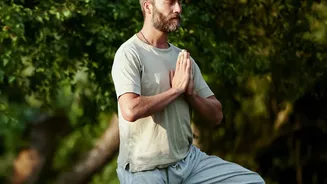
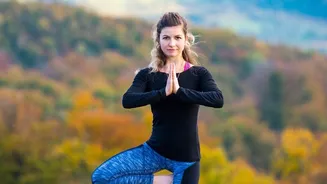
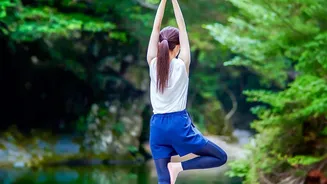
Before you can progress, grounding yourself in a proper Tree Pose is essential. Start in Mountain Pose (Tadasana), standing tall with your feet together or hip-width apart. Shift your weight onto your left foot, engaging the muscles of your standing leg.
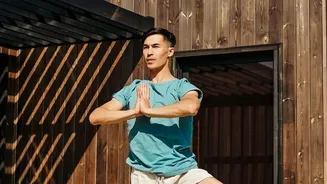
Bend your right knee and place the sole of your right foot on your inner left ankle, calf, or thigh, making sure to avoid placing it directly on your knee joint. Press your foot and thigh firmly against each other to create stability. Keep your hips level and facing forward. Bring your hands to a prayer position at your heart or extend them overhead like branches. Hold your gaze on a fixed point in front of you to aid your balance. The benefits are immense: it strengthens the legs, ankles, and core, improves posture, and enhances concentration.
From Stability to Strength: The Logic of Progression
Once you feel steady in Tree Pose, you might wonder, ‘what’s next?’. The goal of a yoga practice is not to perfect a single pose but to build a conversation between strength, flexibility, and balance. Tree Pose teaches you how to create stability on one leg, engage your core, and maintain focus. Progressing from this static hold to a more dynamic pose like Warrior III challenges that stability in a new way. It takes the balance you’ve cultivated and adds the elements of momentum and horizontal alignment, demanding more from your core and the entire back side of your body. This transition is a natural evolution, turning the rooted energy of the tree into the focused, forward-moving energy of a warrior.
The Next Step: Transitioning to Warrior III
Warrior III (Virabhadrasana III) is a powerful balancing pose that builds full-body strength. To transition from Tree Pose on your left leg, bring your hands back to your heart center. Slowly begin to release your right foot from your inner thigh and extend it straight behind you. As your leg lifts, hinge forward at your hips, lowering your torso until it is parallel to the floor. Your body should form a 'T' shape. Keep a micro-bend in your standing knee to protect the joint and activate the muscles. Extend your arms forward, out to the sides like airplane wings, or keep them at your heart. The key is to move with control, using the strength from your standing leg and core that you developed in Tree Pose.
Finding Your Line: Alignment in Warrior III
Proper alignment in Warrior III is crucial for stability and safety. The most common mistake is opening the hip of the lifted leg, which disrupts your balance. Actively rotate your back thigh inward so your hips remain square to the floor. Imagine your back pinky toe pointing straight down. Engage your core by drawing your navel toward your spine to support your lower back. Your head, torso, and lifted leg should be in one long line. Keep your gaze soft and directed at a single point on the floor just ahead of you. It’s less about how high you can lift your leg and more about maintaining a strong, straight line of energy from your heel to the crown of your head.
Exploring Other Branches: More Tree Variations
Warrior III is just one path forward. There are many other variations of Tree Pose that can deepen your practice. For a different kind of challenge, try a Bending Tree Pose by adding a side-bend while in the posture. You can also explore a Twisted Tree, rotating your upper body while keeping your hips stable. For a deeper hip opener, you can work toward a Half-Lotus Tree Pose (Ardha Padmasana in Vrksasana), placing the top of your foot on the opposite hip crease. Each variation offers a new way to explore your balance, focus, and physical awareness, reminding you that there are many ways for a tree to grow.