





A New Space Age Unfolds in India
For decades, a career in India's space sector was synonymous with the Indian Space Research Organisation (ISRO). But a monumental policy shift in 2020 has opened the final frontier to private enterprise, triggering a boom. The government established the Indian National
Space Promotion and Authorisation Centre (IN-SPACe) as a single-window agency to facilitate and regulate private participation. This has led to an explosion of startups, with over 400 now active in the country, building everything from launch vehicles to satellite constellations. The Indian space economy, valued at around $8.4 billion, is projected to surge to $44 billion by 2033, creating a massive demand for skilled professionals. This is not a distant dream; it's a rapidly expanding industry actively looking for talent.
For Engineers: Building the Future of Spaceflight
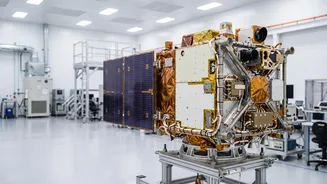
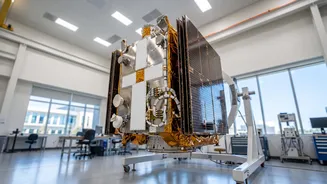
The engineering opportunities in India's space sector now extend far beyond traditional aerospace roles. While aerospace engineers remain crucial for designing spacecraft and launch vehicles, there's a growing need for mechanical, electronics, and materials engineers. Private companies like Skyroot Aerospace and Agnikul Cosmos, focused on building cost-effective launch vehicles, require engineers to work on propulsion systems, structural analysis, and thermal management. Satellite manufacturers such as Dhruva Space need electronics and communication engineers to design and build robust satellite buses and communication payloads. These roles involve everything from CAD modelling and systems integration to testing and quality control, offering a chance to work on tangible hardware that will operate in the harsh environment of space.
For Coders: The Software Powering the Mission
A modern space mission is fundamentally a software and data challenge. This has created a wealth of opportunities for computer science graduates and coders. Both ISRO and private firms are hiring software engineers for a wide range of critical tasks. Roles include developing flight software for spacecraft control, creating complex simulations to test systems before launch, building secure ground control systems, and writing algorithms for autonomous navigation. Strong skills in languages like C++, Python, and experience with embedded systems or Real-Time Operating Systems (RTOS) are highly valued. Furthermore, with the increasing threat of cyberattacks, cybersecurity experts are needed to protect critical space assets, from satellites to ground stations.
For Analysts: Turning Space Data into Gold
One of the most commercially significant parts of the space economy is the downstream application of data collected from satellites. This has created a huge demand for data scientists and geospatial analysts. Companies like Pixxel, which is building a constellation of hyperspectral imaging satellites, and SatSure, which focuses on agriculture and climate analytics, are at the forefront of this revolution. Analysts in this field use satellite imagery and signals to provide insights for diverse sectors, including agriculture, urban planning, disaster management, insurance, and defence. Key skills include proficiency in Geographic Information Systems (GIS), remote sensing techniques, machine learning, and AI to process vast datasets and extract actionable intelligence. This field allows analysts to solve real-world problems on Earth using data from space.
Who Is Hiring and What You Need
ISRO remains a primary employer, recruiting through its Centralised Recruitment Board (ICRB) exam and GATE scores for various scientist and engineer positions. However, the private sector offers a dynamic and fast-paced alternative. Key players actively hiring include Skyroot Aerospace, Agnikul Cosmos, Pixxel, Dhruva Space, and Bellatrix Aerospace. To enter the field, a strong academic foundation in engineering (Aerospace, Mechanical, Electronics, Computer Science), Physics, or Mathematics is typically required. Beyond a degree, practical skills are what make a candidate stand out. Proficiency in tools like MATLAB, Python, CAD software (like SolidWorks or CATIA), and Systems Tool Kit (STK) is essential. Internships and hands-on projects, such as participating in CubeSat clubs, can provide invaluable experience.