


Cosmic Ghosts: The Elusive Intermediate-Mass Black Hole
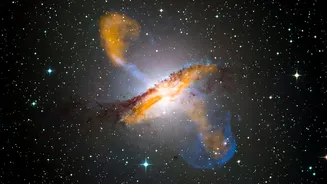
For years, astronomers knew of two main types of black holes. There are the stellar-mass ones, just a few dozen times heavier than our sun, left behind by the collapse of giant stars. Then there are the supermassive behemoths, millions or billions of times our sun's
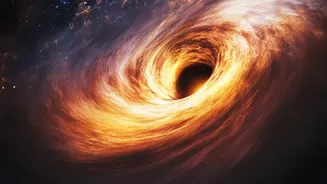
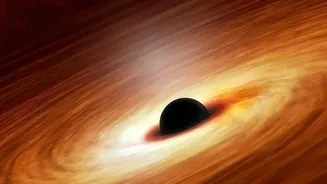
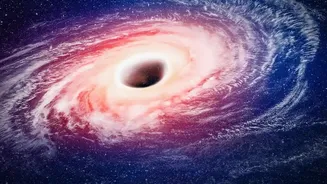
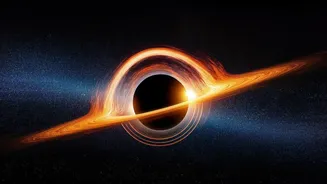
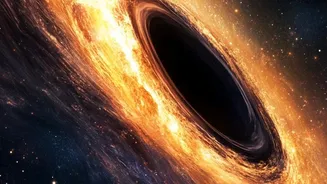
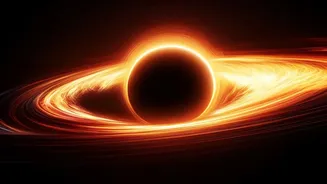
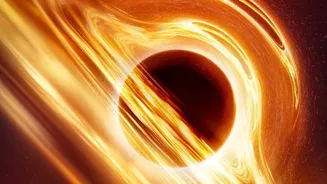
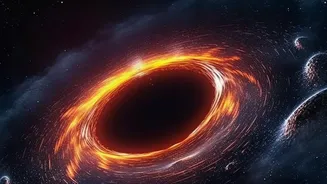
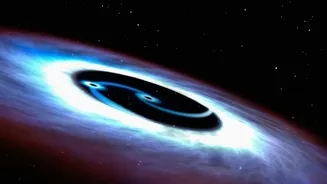
mass, that anchor the centers of galaxies like our own Milky Way. But what about the ones in between? This group, known as intermediate-mass black holes (IMBHs), with masses from 100 to 100,000 times that of the sun, were long considered a 'missing link' in cosmic evolution. They are too big to form from a single star's death but their origin story was unclear. Recent discoveries, however, are finally bringing these cosmic ghosts out of the shadows, suggesting they form in densely packed star clusters through repeated mergers of smaller black holes.
A Ripple Through Spacetime
When two black holes, especially massive ones like IMBHs, spiral towards each other and collide, they unleash a cataclysmic event that sends powerful ripples through the very fabric of the universe. These are gravitational waves, first predicted by Albert Einstein over a century ago. You can think of spacetime as a stretched trampoline; massive objects create dips, and when they move violently, they create waves that spread outwards. Observatories like LIGO in the United States, Virgo in Italy, and KAGRA in Japan are designed to detect these incredibly faint wobbles. By the time the waves reach Earth from millions of light-years away, the distortion they cause is thousands of times smaller than an atomic nucleus, making their detection a monumental feat of engineering.
The Universe's Loudest Sirens
The signal from a black hole merger isn't just random noise; it's a precise signature that carries a wealth of information. The shape and frequency of the gravitational wave tell scientists the masses of the colliding black holes and how much energy was released. Because the physics of these mergers is so well understood, they serve as a 'standard siren'. Just as we know how bright a 100-watt light bulb should be and can estimate its distance by how dim it appears, scientists can calculate the intrinsic strength of a gravitational wave event. By comparing that to how faint the signal is when it reaches our detectors, they can precisely measure its distance from Earth. Mergers involving IMBHs are particularly valuable because they are so energetic they can be detected from much farther away, deep into the universe's past.
Mapping the Cosmic Expansion
This ability to accurately measure vast distances gives cosmologists a new tool to tackle one of the biggest questions in physics: how fast is the universe expanding? This value, known as the Hubble constant, is crucial for determining the age and ultimate fate of the cosmos. Currently, the two primary methods for measuring it yield conflicting results, a puzzle known as the 'Hubble tension'. Gravitational waves from standard sirens offer a completely independent third way to make this measurement. By detecting a merger's gravitational wave (which gives the distance) and then finding its host galaxy with a traditional telescope to measure its redshift (which gives its speed), scientists can calculate the expansion rate. The growing catalogue of these events, especially powerful ones involving IMBHs, is helping to refine this measurement and could resolve the discrepancy, or even point to new physics missing from our current model of the universe.