





A Trail of Compelling Clues
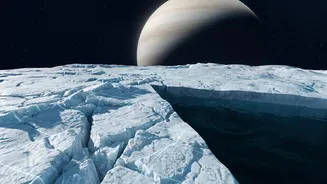
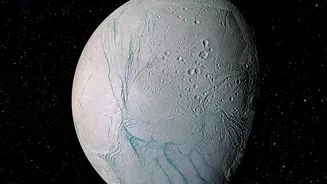
The idea of a Europan ocean isn't new. Since the Voyager and Galileo missions of the 20th century, scientists have gathered mounting evidence. Images revealed a surprisingly smooth surface, crisscrossed by massive cracks and ridges but lacking the ancient,
heavy cratering seen on other moons. This suggests the surface is geologically young and active, constantly being resurfaced, perhaps by water from below. Further evidence came from Galileo's magnetometer, which detected a distorted magnetic field around Europa. This strongly implies the presence of a global, electrically conductive layer—and the best candidate for that is a salty liquid water ocean. The Hubble Space Telescope even spotted what appear to be plumes of water vapor erupting into space, offering a potential glimpse of the ocean without ever needing to drill.
The Robotic Detective on the Case
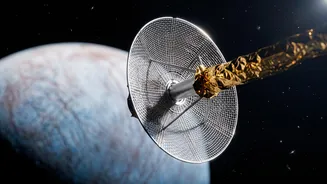
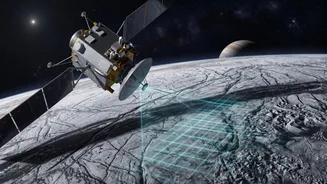
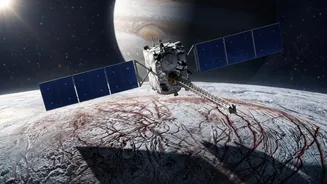
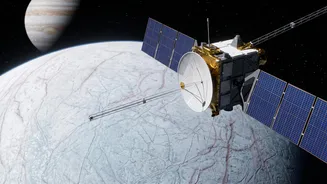
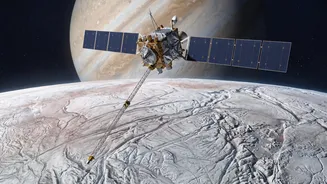
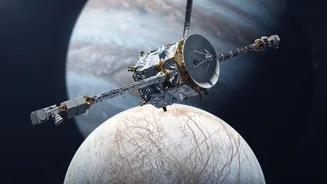
Launched in October 2024, the Europa Clipper is the largest interplanetary spacecraft NASA has ever built for a planetary mission. It is specifically designed to investigate Europa’s potential habitability. However, it won't actually orbit Europa directly. The radiation environment so close to Jupiter is incredibly intense, so the Clipper will instead enter a long, looping orbit around Jupiter itself. From there, it will perform nearly 50 close flybys of Europa, some as low as 25 kilometers above the surface. This strategy allows the spacecraft to gather detailed data during its brief, targeted encounters while spending most of its time in a safer, less radioactive part of space, extending the life of its sensitive electronics.
A Toolkit for Uncovering an Ocean
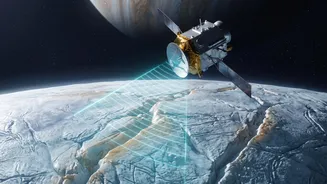
To confirm the ocean’s existence and learn about its properties, the Clipper is equipped with a powerful suite of nine science instruments. Chief among them is an ice-penetrating radar called REASON (Radar for Europa Assessment and Sounding: Ocean to Near-surface). It will send radio waves through the ice shell, seeking a reflection from a liquid water layer below, which could be up to 30 kilometers deep. A magnetometer will precisely measure the magnetic field distortion, which can help determine the ocean's depth and salinity. Meanwhile, a thermal imager will scan for hotspots on the surface, potential signs of recent eruptions of warmer water. Other instruments, like mass spectrometers, will even analyze the thin atmosphere and any particles ejected from the moon, hoping to directly 'taste' the ocean by flying through one of its plumes.
The Long Voyage to Jupiter
Getting this massive spacecraft to Jupiter is a marathon, not a sprint. The mission is currently on a 5.5-year, 2.9-billion-kilometer journey. To get the speed it needs, the Clipper is using gravity assists—a kind of cosmic slingshot maneuver. It already flew past Mars in March 2025 to adjust its trajectory. As of late 2026, it is heading back toward our home planet for a crucial Earth gravity assist in December 2026. This flyby will give it the final boost needed to reach the outer solar system. Arrival at Jupiter is scheduled for April 2030, after which it will begin its detailed scientific survey of Europa.
The Ultimate Question: Is Europa Habitable?
Confirming a subsurface ocean is just the first step. The ultimate goal of the Europa Clipper mission is to determine if this ocean world has the necessary ingredients for life as we know it: liquid water, essential chemical elements, and a source of energy. The reddish-brown streaks on Europa’s surface may be salts and other chemicals from the ocean, and analyzing their composition could reveal if the ocean is interacting with the rocky seafloor, a process that could supply nutrients. By measuring the ocean’s salinity, depth, and the thickness of the ice shell, and by sampling any plumes, Clipper will paint the most detailed picture yet of this mysterious world. It won’t be looking for life itself, but it will help us understand if Europa is a place where life could exist.