

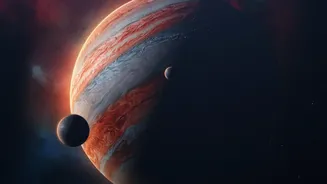
The Shadow Tells the Story
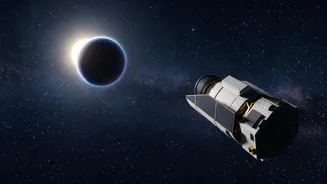
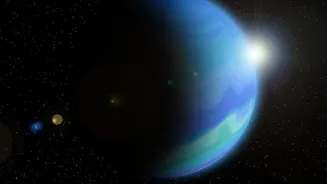
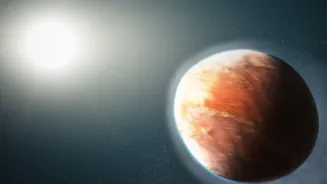
The hunt begins with a simple, yet ingenious method called transit photometry. Astronomers wait for a planet to pass directly in front of its star from our point of view. As it does, it blocks a tiny fraction of the starlight, causing a minuscule, temporary
dip in the star's brightness. This event, known as a transit, confirms the planet's existence and can tell us its size. But the real magic happens in that sliver of starlight that grazes the very edge of the planet, passing through its atmosphere before continuing its journey to our telescopes. That light carries a secret message.
Decoding the Barcode of Light
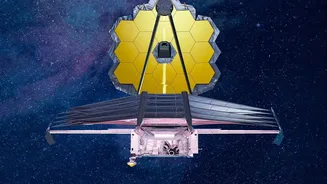
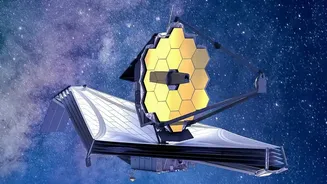
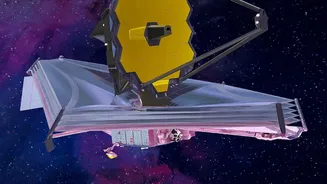
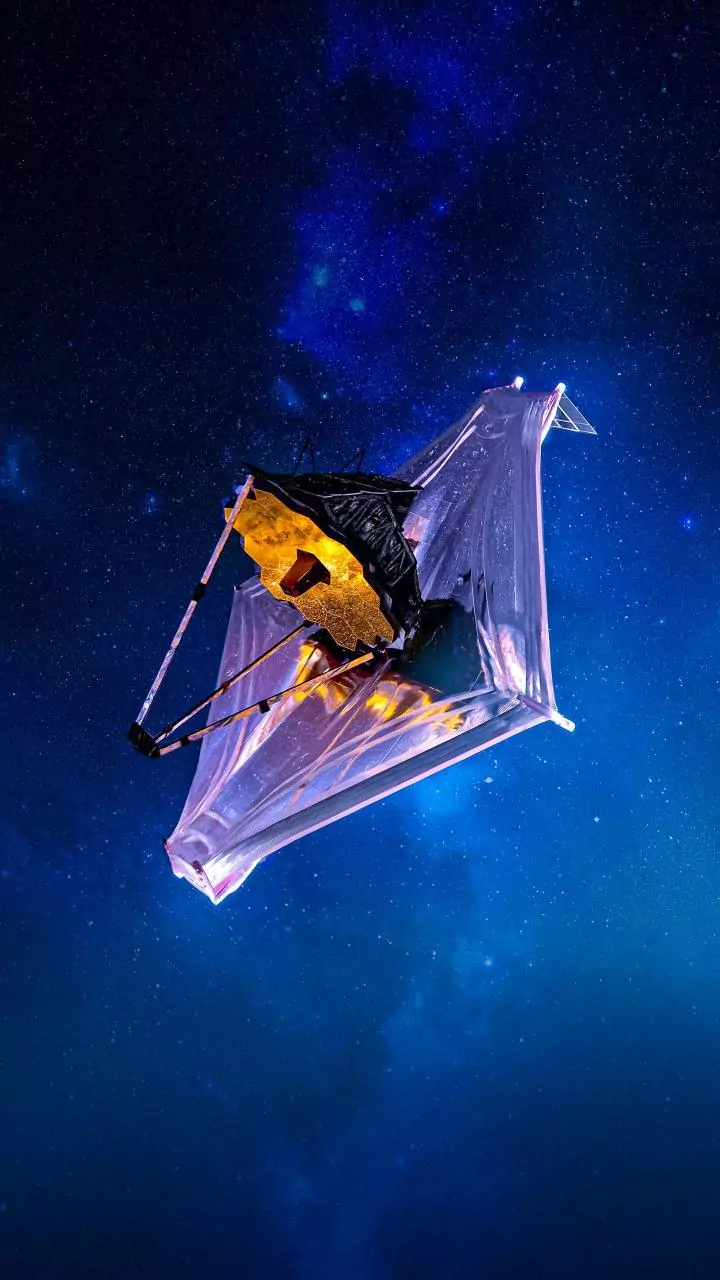
This is where a technique called transit spectroscopy comes in. Think of starlight as a pure, white light containing all the colours of the rainbow. When that light filters through a planet’s atmosphere, the gases present absorb very specific colours, or wavelengths, of that light. Each gas—like water, carbon dioxide, or methane—has a unique absorption pattern, like a chemical barcode. Advanced instruments, such as the Near-Infrared Spectrograph (NIRSpec) on the James Webb Space Telescope (JWST), are designed to split this starlight into its full spectrum, revealing which colours are missing. Those missing bands are the fingerprints, telling astronomers exactly what the alien atmosphere is made of.
The Telltale Trio: Water, Methane, and CO2
While many chemicals can be detected, a combination of water, carbon dioxide (CO2), and methane (CH4) is particularly exciting for astrobiologists. Water is essential for life as we know it. Carbon dioxide is a fundamental building block for biological processes like photosynthesis. Methane, meanwhile, is heavily produced by life on Earth, from microbes to livestock. Detecting these gases in the atmosphere of a rocky, Earth-sized planet located in the 'habitable zone'—the region around a star where liquid water could exist—is a major step. For instance, JWST has already detected CO2 and methane in the atmosphere of the exoplanet K2-18 b.
The Search for Disequilibrium
However, just finding these gases isn't definitive proof of life, as they can also be produced by geological processes like volcanic activity. The real smoking gun is what scientists call 'chemical disequilibrium'. On Earth, methane and oxygen don't naturally coexist for long; they react with and destroy each other. The only reason we have both in our atmosphere is that life is constantly replenishing them. Therefore, finding a similar imbalance on another world—gases that shouldn't be there together—would be a powerful indicator that some active process, possibly biological, is maintaining that mixture. The simultaneous presence of methane and carbon dioxide with a distinct lack of carbon monoxide is considered another strong potential biosignature.
A Case of Cosmic Caution
The search for biosignatures is a painstaking process of building evidence, not a single 'eureka' moment. Scientists must be incredibly careful to rule out all possible non-biological explanations for what they see. Factors like the type of star, the planet's geology, and potential atmospheric phenomena like clouds or haze can create signals that mimic biosignatures, leading to false positives. Each detection is a clue, not a conclusion. It pushes researchers to gather more data and refine their models, bringing us incrementally closer to understanding whether other worlds might harbor life.