



A Cosmic Volcano Reawakens
In the heart of a galaxy cluster nearly 10 billion light-years away, a sleeping giant has awoken. Astronomers recently detailed a remarkable event where a supermassive black hole, after a long period of quiet, suddenly flared to life. This dramatic “activation”
was so brilliant that it became one of the brightest transient events—objects that rapidly change in brightness—ever recorded. The discovery, centered on an object named J221951, was made by a team of astronomers who were initially searching for something else entirely: the afterglow of a gravitational wave event. What they found instead provides a rare glimpse into the life cycle of these cosmic behemoths. After brightening for about 10 months, the object began to fade, confirming it was a temporary, high-energy outburst and not a permanent new feature of the sky.
What Makes a Black Hole 'Active'?
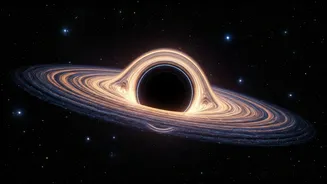
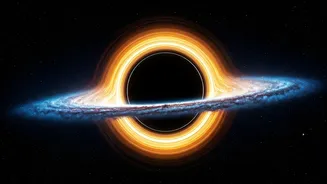
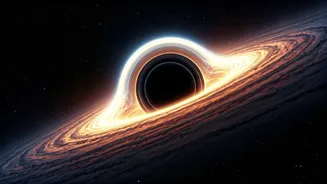
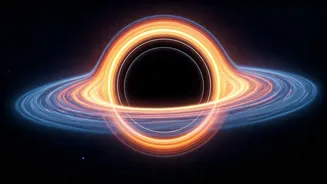
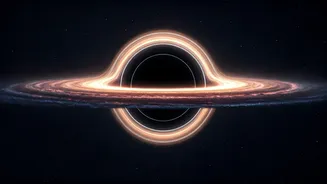
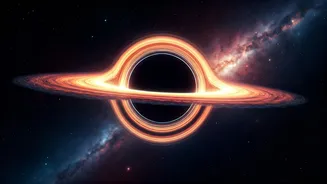
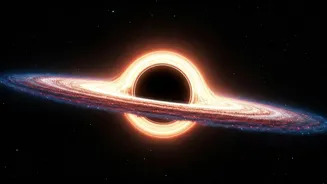
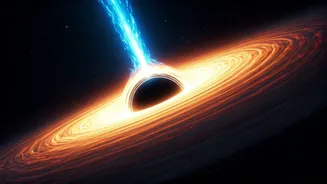
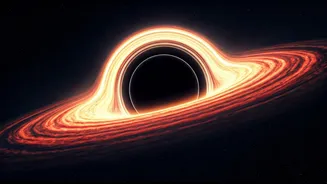
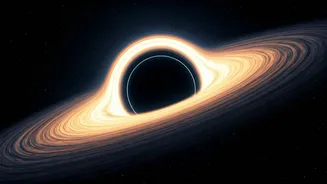
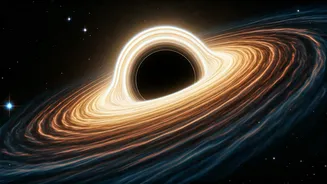
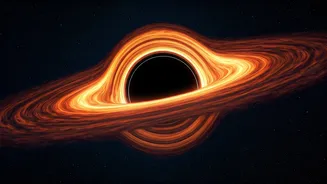
Most large galaxies, including our own Milky Way, are believed to host a supermassive black hole at their center. For the most part, these black holes are dormant, meaning they are not actively consuming large amounts of matter. An 'active' black hole, however, is a different beast entirely. When gas, dust, and even stars drift too close, they get pulled into a swirling disk of material around the black hole called an accretion disk. The immense gravitational forces and friction heat this material to millions of degrees, causing it to glow brightly across the electromagnetic spectrum. This turns the galactic center into what astronomers call an Active Galactic Nucleus (AGN), or a quasar in its most luminous form, capable of outshining all the stars in its host galaxy combined.
A Surprisingly Fast Transition
The long-held view was that the transition from a dormant to an active state was a slow, gradual process that unfolded over many thousands of years. The latest findings challenge this notion directly. The sudden and intense brightening of J221951 suggests a black hole can flip the switch from dormant to fully active in a cosmic blink of an eye. This rapid activation is what makes the timeline so 'extraordinary'. Scientists are now considering two main possibilities for what caused this sudden feast. One theory is a tidal disruption event, where a star wandered too close and was shredded by the black hole's gravity, providing a sudden influx of fuel. The other, perhaps more profound, theory is that this is a 'changing state' event, where the accretion disk around the black hole became unstable and suddenly collapsed inward, triggering a massive burst of energy.
Rewriting the Rules of Galaxy Evolution
This discovery has significant implications for how we understand the evolution of galaxies. The energy blasted out by an active black hole can have a profound impact on its host galaxy, heating or expelling gas that would otherwise form new stars. If black holes can turn on and off much more quickly than previously thought, their influence on their galactic environments could be far more dynamic and chaotic. It suggests that the relationship between a supermassive black hole and its galaxy is not a slow dance, but a series of rapid, transformative events. According to Dr. Matt Nicholl of Queen's University Belfast, “J221951 is one of the most extreme examples yet of a black hole taking us by surprise.” This event, and others like it, are providing a new framework for understanding the powerful, intermittent feedback loop between black holes and the galaxies they inhabit.