


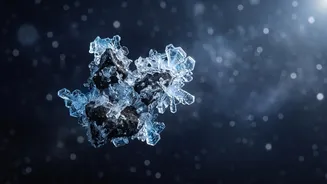
A Frozen Frontier
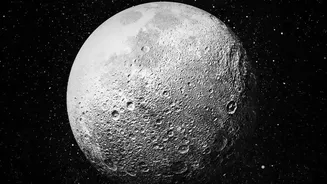
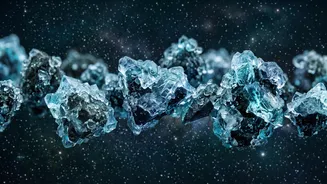
Far beyond the orbit of Neptune lies a vast, doughnut-shaped region of icy bodies known as the Kuiper Belt. This cosmic junkyard is filled with millions of frozen remnants from the formation of our solar system, including dwarf planets like Pluto. Because
these objects are so distant and cold, they are considered pristine time capsules, preserving the original chemical makeup of the early solar system. For decades, scientists have theorized about the composition of these bodies, but their extreme distance makes them incredibly difficult to study directly.
Catching Cosmic Dust
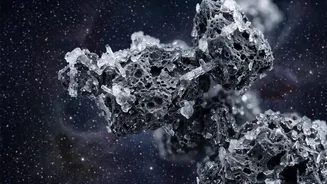
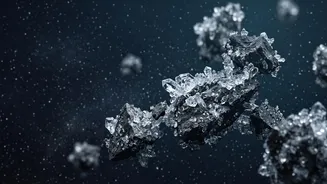
While we have only sent one spacecraft, New Horizons, to visit the Kuiper Belt, tiny pieces of this distant region come to us. Interplanetary dust particles constantly rain down on Earth. By flying aircraft high into the stratosphere, NASA can collect these minuscule grains. The challenge is determining where they came from. Scientists do this by looking for 'travel scars'. As dust journeys through space, it's bombarded by energetic particles from the sun, which leave tiny tracks in the mineral structure. Grains with a very high density of these tracks must have travelled for a very long time, pointing to an origin in the far reaches of the solar system, like the Kuiper Belt.
The Signature of Water
In a recent study led by Lindsay Keller, scientists analyzed 12 of these well-travelled dust particles. Using advanced electron microscopy, they discovered that the grains were full of hydrated minerals, particularly clays like saponite and serpentine. These types of minerals can only form through a process called aqueous alteration, which is a fancy way of saying they are the result of rock reacting with liquid water. This finding provides compelling evidence that liquid water must have existed at some point inside the parent bodies from which these dust grains originated billions of years ago.
A Reservoir of Heavy Water
The discovery got even more interesting when the team analyzed the specific 'flavour' of the water involved. By studying the oxygen isotopes within the clay minerals, they found the signature of 'heavy' oxygen. The water that formed these minerals was significantly enriched in heavy oxygen isotopes (oxygen-17 and oxygen-18) compared to water found on Earth or in meteorites from the asteroid belt. This indicates that the water in the Kuiper Belt came from a vast, primordial reservoir that was largely isolated from the chemical mixing that occurred in the inner solar system as the planets were forming.
Rewriting Solar System History
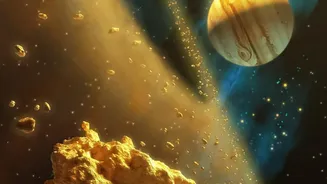
So how could these frozen worlds, where surface temperatures are incredibly low, have once hosted liquid water? Scientists believe that heat from the decay of radioactive elements within the interiors of these ancient objects could have been sufficient to melt ice, allowing it to react with rock and form the minerals we now see in the dust. The discovery of this isolated heavy water reservoir provides a crucial new data point for models of how our solar system formed and evolved. It suggests that the formation of the giant planets, like Jupiter, may have acted as a barrier, preventing material from the outer solar system from mixing with material from the inner solar system. This finding helps explain the chemical variations we see across our cosmic neighbourhood.