
A New Light in the Heavens
In early October 1604, observers across Europe and Asia noticed a powerful new light in the constellation Ophiuchus. It shone brighter than any star and even surpassed the brilliance of Jupiter. Though others saw it first, German astronomer Johannes Kepler
began a meticulous year-long study of the object, and his detailed work, 'De Stella Nova' (On the New Star), forever linked his name to the event. For 18 months, it was visible to the naked eye before finally fading from view. At the time, thinkers like Kepler and Galileo used the supernova to argue against the Aristotelian idea of an unchanging, perfect cosmos, proving that real changes could and did occur in the heavens.
What Kepler Actually Witnessed
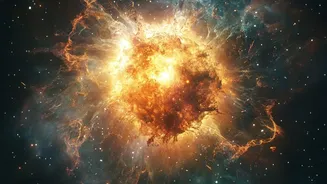
Kepler believed he was watching the birth of a star, but modern astronomy knows he was witnessing its violent death. SN 1604 is now classified as a Type Ia supernova. This type of explosion doesn't come from a single, massive star collapsing. Instead, it happens in a binary star system where a small, dense star called a white dwarf siphons material from a companion star. Once the white dwarf reaches a critical mass, it triggers a runaway thermonuclear explosion that completely obliterates it, leaving no central star behind. This process creates and scatters heavy elements like iron. In fact, Type Ia supernovae are responsible for creating more than half of all the iron in the universe.
The Cosmic Debris Field
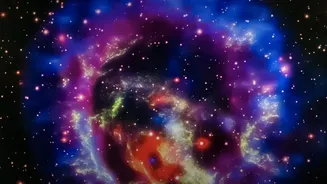
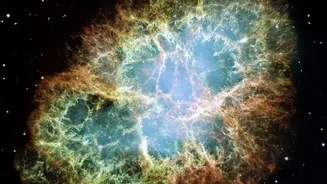
Today, some 20,000 light-years from Earth, the aftermath of that explosion continues to expand. The Kepler supernova remnant is a beautiful, turbulent cloud of gas and dust about 14 light-years wide, rushing outward at millions of miles per hour. Because it is so distant and faint, it wasn't rediscovered until 1941. Modern observatories like the Hubble Space Telescope, Chandra X-ray Observatory, and Spitzer Space Telescope have given us a stunning multi-wavelength view of this cosmic wreckage. These images show where the explosion’s shockwave is slamming into interstellar gas and dust, heating it to millions of degrees and causing it to glow brightly in X-rays, infrared, and visible light.
What Massive Stars Leave Behind
While Kepler's supernova came from a white dwarf, the headline also asks what massive stars leave behind. Their end is even more dramatic. Stars more than eight times the mass of our Sun end their lives in what’s called a core-collapse, or Type II, supernova. After fusing lighter elements into heavier ones for millions of years, they create an iron core they cannot burn. Gravity wins, the core collapses catastrophically, and the star's outer layers are blasted into space. This explosion leaves behind an incredibly dense core. For stars between about 10 and 25 times the Sun's mass, this remnant is a neutron star—an object so dense that a matchbox of its material would have an immense weight. For stars even more massive, gravity crushes the core so completely that it forms a black hole, an object from which not even light can escape.
We Are All Made of Stardust
Whether from a Type Ia or a Type II, supernovae are the universe's primary chemical factories. The intense heat and pressure of the explosion forge elements heavier than iron, such as gold, silver, and uranium, which cannot be created in the normal life of a star. The explosion then scatters these new elements, along with elements like carbon and oxygen created during the star's life, across the galaxy. This material enriches the interstellar medium, providing the raw ingredients for new stars, new planets, and eventually, life itself. The iron in our blood and the calcium in our bones were all forged in the heart of a long-dead star and flung across space in a supernova.