


A Land of Disappearing Water
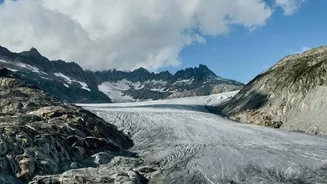
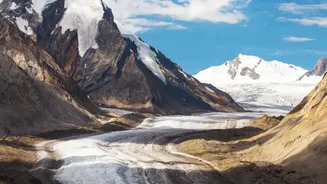
Ladakh, a stunning cold desert in the Himalayas, faces a severe paradox. With annual rainfall often less than 100mm, communities have traditionally depended on the seasonal meltwater from glaciers to irrigate their crops like barley and potatoes. However,
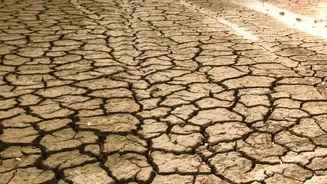
climate change is disrupting this ancient rhythm. Glaciers are receding at an alarming rate, and winter snows are becoming less predictable. This leads to a critical water shortage in the crucial spring planting months of April and May, as the natural glacial melt now often arrives too late in the summer, threatening the region's food security and livelihoods.
The Simple Genius of an Ice Stupa
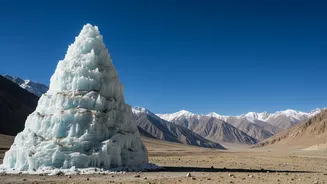
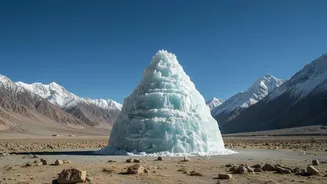
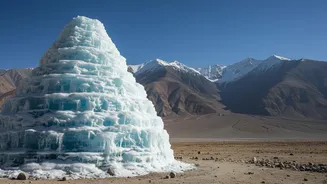
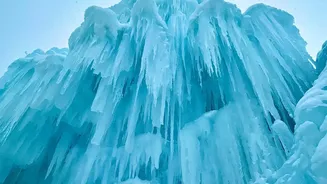
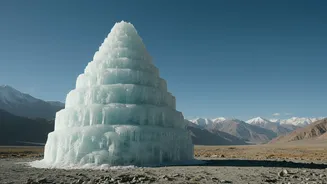
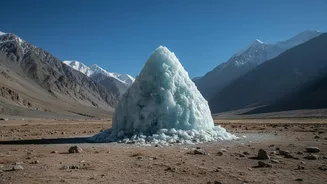
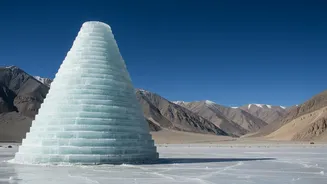
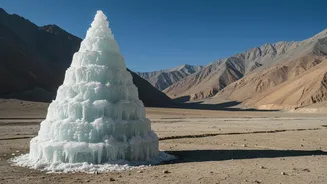
Enter the ice stupa, an invention by Ladakhi engineer and innovator Sonam Wangchuk. The concept is elegantly simple and rooted in basic physics. In winter, when stream water is abundant but not needed for farming, a network of underground pipes channels it from a higher altitude. The force of gravity pushes the water down the pipe and up through a vertical sprinkler at a lower elevation, without needing any external pumps or power. In the freezing sub-zero air of the Ladakhi winter, this spray of water freezes as it falls, gradually forming a massive, cone-shaped mound of ice that resembles a traditional Buddhist stupa.
Why A Cone Is The Coolest Shape
The conical shape is a key piece of engineering brilliance. Wangchuk was inspired by high-school geometry: a cone exposes the minimum possible surface area to the sun for a given volume of ice. Unlike a flat, horizontal sheet of ice that would melt quickly under the spring sun, the vertical cone protects its own mass. This design allows the ice stupa to melt very slowly, releasing water steadily throughout the spring, precisely when farmers need it most to sow their crops. A single ice stupa can hold millions of litres of water, acting as a frozen reservoir that bridges the gap between the start of the farming season and the arrival of natural glacier melt.
Global Scientists Take Notice
The ice stupa's low-tech, high-impact model is precisely why the global scientific community is so interested. It's a powerful example of passive climate adaptation. Researchers are studying the technology for its efficiency, scalability, and reliance on gravity and temperature differentials alone. This makes it a potential solution for other mountainous, arid regions facing similar water crises. Projects and studies have already been initiated in the Swiss Alps and the Chilean Andes, directly inspired by the Ladakhi model. Universities and research groups are now working to quantify the potential of these artificial ice reservoirs, create models to predict their effectiveness in different climates, and refine the technology for wider application.
From Local Fix to Global Movement
What started as a local experiment in 2013 has blossomed into a community-driven movement. Annual competitions encourage villages across Ladakh to build their own stupas, fostering a sense of ownership and spreading technical knowledge. This community-led approach, combined with its affordability and effectiveness, makes it a powerful model for climate resilience. It's not just about storing water; it’s about empowering local communities to find solutions to their own problems using a blend of modern science and contextual knowledge. Organizations like the Himalayan Institute of Alternatives, Ladakh (HIAL), co-founded by Wangchuk, are dedicated to developing and scaling such sustainable mountain solutions.