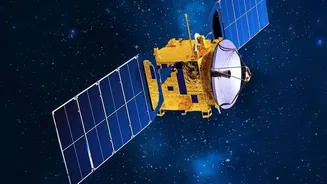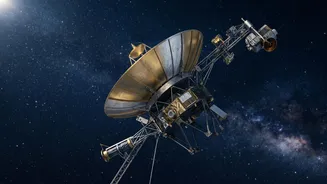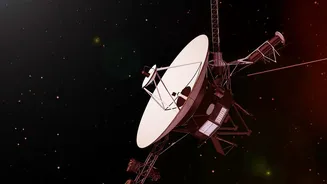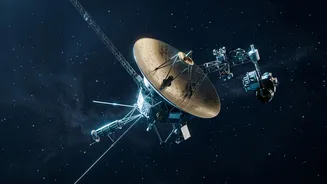




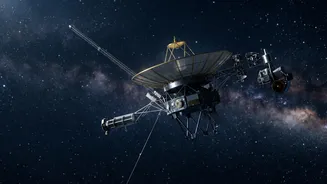
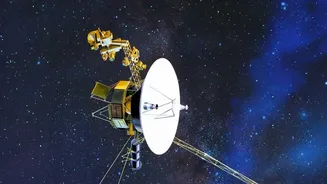
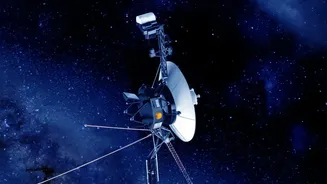
After nearly 49 years adrift in the cosmos, humanity’s most distant emissary, Voyager 1, recently gave its creators a scare, falling silent for 48 hours. NASA has confirmed contact is restored, but the incident is a stark reminder of the challenges ahead.
A Call from the Void
In mid-October 2026, mission controllers at NASA's Jet Propulsion Laboratory (JPL) held their breath. During two scheduled check-ins, the Deep Space Network—a global array of giant antennas—heard nothing but static from Voyager 1. For 48 nail-biting hours, the probe was silent. Then, on October 20, a signal reappeared. The spacecraft had fixed itself before a command could even be sent from Earth, a remarkable feat of autonomous engineering. Kareem Badaruddin, the Voyager mission manager at JPL, expressed the team's relief and eagerness to understand what happened, noting that at this stage of the mission, they must 'expect the unexpected'.
Diagnosing a Distant Patient
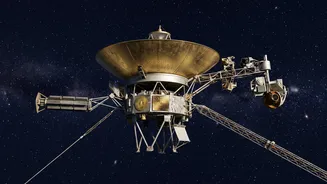
Engineers quickly began investigating the cause of the blackout. Initial findings suggest the probe’s fault protection system kicked in automatically. It appears one group of thrusters—small engines that keep the spacecraft oriented—went offline, prompting a backup set to take over. This safety protocol puts the probe in a stable 'safe mode', pausing normal operations to give engineers time to diagnose the issue from over 25 billion kilometres away. The challenge is immense; a radio signal takes nearly 24 hours to reach Voyager 1, and another 24 hours for a response to travel back. A simple 'hello' requires a two-day wait for the reply.
The Constant Battle Against Fading Power
While the recent thruster issue appears resolved, it underscores the larger, more pressing threat to the mission: dwindling power. The Voyager probes are powered by radioisotope thermoelectric generators (RTGs), which convert heat from decaying plutonium into electricity. This power source has served the mission for nearly five decades, but its output decreases by about four watts each year. With power margins razor-thin, the JPL team has become masterful at energy conservation, progressively shutting down nonessential systems and instruments to keep the mission alive.
The 'Big Bang' and a Race Against Cold
Just weeks before the communication scare, engineers executed a clever power saving manoeuvre nicknamed the 'Big Bang'. This complex operation involved simultaneously swapping three power hungry heating devices for lower power alternatives. The procedure was critical not just for saving electricity, but for ensuring heat remained properly distributed to keep the spacecraft's systems from freezing in the frigid expanse of interstellar space. Without this upgrade, NASA would have likely needed to shut down another of Voyager 1’s precious science instruments as early as next summer.
Why This 49 Year Old Probe Still Matters
Launched in 1977, Voyager 1 and its twin, Voyager 2, completed their grand tour of the outer planets decades ago. Since 2012, Voyager 1 has been charting a course through interstellar space, the region outside the protective bubble of our sun's influence known as the heliosphere. They are the only spacecraft to ever directly study this region, sending back invaluable data on the interstellar medium—the mix of particles and magnetic fields between stars. As it continues its journey, Voyager 1 is approaching another historic milestone: on November 18, 2026 , it will be one light day from Earth , a testament to its incredible endurance.