

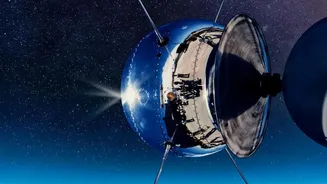
The New Frontier for Space
Modern space exploration is no longer just about building powerful rockets and resilient satellites. It has become a challenge of computation and data. The sheer volume of information beamed back from Earth-observation satellites, deep-space probes, and rovers
is staggering. Similarly, the complexity of managing multi-satellite constellations, ensuring autonomous navigation millions of kilometres from home, and protecting sensitive communications requires tools that go beyond conventional computing. This is where emerging technologies like Artificial Intelligence (AI) and quantum computing become indispensable. For ISRO, adopting these technologies is not just an upgrade; it is a fundamental necessity to maintain its competitive edge and expand its capabilities in the 21st century.
AI: The Intelligent Co-Pilot
Artificial Intelligence is already an integral part of ISRO's operations, acting as a smart assistant for complex tasks. For instance, the Chandrayaan missions utilised AI-powered sensors and algorithms for hazard detection, helping the lander analyse the lunar surface in real-time to find a safe touchdown spot. AI is also being developed for autonomous spacecraft navigation, which will reduce the reliance on constant communication with ground control on future deep-space missions. Beyond missions, AI is critical on the ground. Machine learning models monitor the health of launch vehicles by analysing telemetry data, predicting potential anomalies before they become critical. These applications demonstrate AI's immediate value in making space missions safer, more efficient, and more autonomous.
AI for Earth: A Universe of Data
Perhaps the most significant impact of AI in ISRO's work is in analysing the vast troves of data from its Earth-observation satellites. The National Remote Sensing Centre (NRSC) uses AI and machine learning to rapidly process satellite imagery for a wide range of national applications. These AI models can identify patterns that a human analyst might miss, leading to more accurate crop yield predictions, better urban planning, and faster disaster assessments during floods or cyclones. For example, AI-enabled systems are being used to monitor forest cover and detect illegal deforestation on a finer scale than ever before, helping to protect India's green resources. By automating data analysis, AI enables ISRO to translate satellite data into actionable insights for governance and public welfare more quickly and effectively.
Quantum: The Unhackable Frontier
If AI is the workhorse of the present, quantum technology is the strategic bet for the future. While full-fledged quantum computers are still evolving, one area where quantum principles are already making an impact is in communications. The primary promise of quantum communication is unconditional security. Conventional encryption relies on mathematical problems that are hard to solve, but which could potentially be broken by future supercomputers. Quantum Key Distribution (QKD), on the other hand, is based on the laws of physics. It allows two parties to create an encryption key, where any attempt by an eavesdropper to intercept it would disturb the quantum state, immediately revealing their presence. This creates a form of communication that is considered 'unhackable'.
ISRO's Quantum Leap
ISRO has already taken significant steps in this domain. Scientists have successfully demonstrated free-space QKD over a distance of 300 metres, transmitting encrypted images and even conducting a video call secured by a quantum key. This was a major breakthrough and a crucial step towards the ultimate goal: Satellite-Based Quantum Communication (SBQC). ISRO plans to develop its own QKD satellite that can facilitate ultra-secure communication across thousands of kilometres, a technology with massive implications for national security, defence, and critical financial infrastructure. Further in the future, ISRO aims to use quantum computers for solving problems currently out of reach, such as designing novel materials for spacecraft or optimising incredibly complex mission trajectories.
A Coordinated National Mission
ISRO's push into these advanced technologies is not happening in isolation. It is part of a broader national strategy. In 2023, the Government of India launched the National Quantum Mission (NQM), a comprehensive, multi-year initiative with a budget of over ₹6,000 crore to build a domestic ecosystem for quantum technology. A key objective of the NQM is to develop satellite-based secure communication for India, a goal that directly aligns with ISRO's work. The mission fosters collaboration between government agencies like ISRO, premier academic institutions such as the IITs and IISc, and the private industry. This coordinated approach ensures that India develops not just the technology, but also the skilled workforce and industrial capacity to become a global leader in the space technologies of tomorrow.