





The New Final Frontier: An Economic Race
Once the exclusive domain of government agencies, space is now a burgeoning global marketplace. For India, this represents a significant economic opportunity. The country's space economy is currently valued at around $8.4 billion, but projections show
it could grow five-fold to between $40-45 billion within the next decade. This ambitious target aims to increase India’s share of the global space economy from the current 2-3% to a more formidable 8-10%. This growth isn't just about launching rockets; it encompasses satellite manufacturing, ground stations, and a vast array of downstream services like satellite communications, earth observation data, and navigation, which have applications in everything from agriculture to disaster management.
ISRO's Commercial Pivot
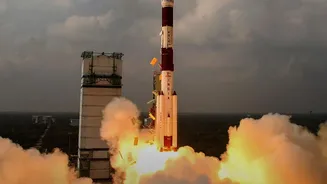
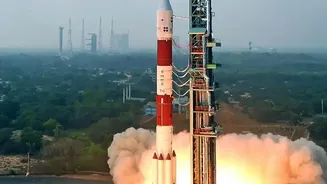
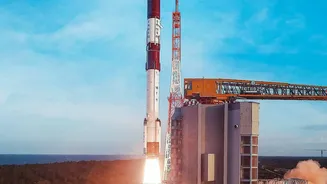
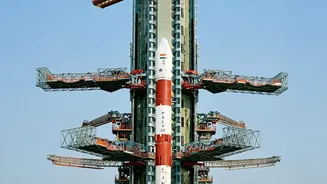
A key driver of this economic expansion is the strategic pivot by ISRO towards deeper commercial engagement. For decades, ISRO's focus was primarily on research and national missions. However, recent reforms have redefined its role. While ISRO continues to spearhead research and complex missions like Gaganyaan, its mature technologies are now being commercialised. This transition is led by NewSpace India Limited (NSIL), ISRO’s commercial arm established in 2019. NSIL is tasked with marketing ISRO's technologies, providing launch services for international customers, and even commissioning the manufacturing of entire launch vehicles and satellites by private industry. This strategy is already yielding impressive results, with NSIL's revenues showing substantial growth, reflecting strong global demand for India's cost-effective and reliable space services.
A Policy Push and the Rise of Startups
This commercial shift is underpinned by a robust policy framework. The Indian Space Policy 2023 clearly delineates the roles of different entities: ISRO as the R&D hub, NSIL as the commercial interface, and the Indian National Space Promotion and Authorisation Centre (IN-SPACe) as the crucial single-window agency for the private sector. Established in 2020, IN-SPACe acts as a promoter and regulator, enabling private companies—referred to as Non-Governmental Entities (NGEs)—to participate in end-to-end space activities. This policy clarity, combined with liberalised FDI norms, has catalysed a startup boom. From just a handful a decade ago, India is now home to over 400 space startups. Companies like Skyroot Aerospace, which launched India's first private rocket, Agnikul Cosmos with its 3D-printed engines, and Pixxel, focusing on hyperspectral earth imaging, are creating a vibrant and diverse commercial space ecosystem.
Beyond the Launchpad: The Downstream Impact
The real economic power of the space sector lies in its downstream applications. The data and services enabled by satellites are creating a significant economic multiplier effect. Satellite imagery helps in precision agriculture and urban planning, while communication satellites are vital for broadcasting and broadband services in remote areas. Navigation systems like NavIC offer strategic autonomy and commercial services. This ecosystem not only creates high-skilled jobs in aerospace engineering but also in data analytics, software development, and manufacturing. By empowering the private sector to handle more routine manufacturing and launch services, ISRO can dedicate its resources to pioneering new frontiers like human spaceflight and deep space exploration, ensuring India remains at the cutting edge of space technology while building a self-reliant and commercially thriving industry.