



The Fiery Problem of Re-Entry
Any object entering Earth's atmosphere at orbital speeds—around 28,000 kilometres per hour—faces immense resistance. Air molecules compress in front of the object, creating a superheated shockwave with temperatures that can exceed 2,700 degrees Celsius.
Without protection, a spacecraft would be incinerated. The traditional solution has been rigid, ablative heat shields, like those on the Apollo capsules, or thermal tiles, like those on the Space Shuttle. These are heavy, expensive, and, most importantly, limited in size by the rocket fairing they launch in. This size constraint directly limits the mass of the payload they can protect, a major hurdle for future deep-space missions.
A Flexible, Inflatable Solution
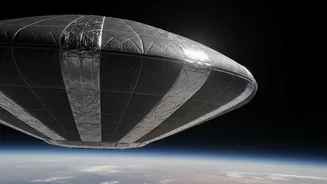
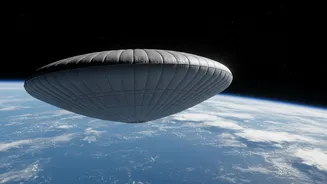
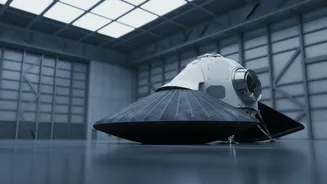
An inflatable heat shield, also known as a Hypersonic Inflatable Aerodynamic Decelerator (HIAD), is exactly what it sounds like: a deployable shield that is packed tightly for launch and inflates in space before re-entry. Instead of a dense, solid structure, it’s made of a flexible, multi-layered thermal protection system. This allows for a much larger shield than could ever fit inside a rocket nose cone, which is the key to its effectiveness. The larger surface area creates significantly more drag, allowing the spacecraft to decelerate more efficiently at higher altitudes where the air is much thinner. This reduces the peak heating and mechanical stress the vehicle experiences.
Advanced Materials That Endure the Heat
The technology relies on advanced materials designed to be both flexible and incredibly heat-resistant. The inflatable structure itself is composed of stacked rings woven from a synthetic polymer that is, by weight, significantly stronger than steel. This provides the rigid shape needed when inflated. The outer layers, which face the intense heat, are made from a woven ceramic fabric, specifically silicon carbide. This material can be spun into a yarn and woven like denim, yet it can withstand the extreme temperatures of re-entry. Underneath this outer layer are additional layers of flexible insulation that prevent heat from reaching the inflatable structure and the precious cargo within.
Proof of Concept: The LOFTID Mission
This technology is not just theoretical. In November 2022, NASA successfully demonstrated its capabilities with the Low-Earth Orbit Flight Test of an Inflatable Decelerator (LOFTID) mission. Launched as a secondary payload, the 6-meter diameter LOFTID shield inflated in orbit, separated from its rocket stage, and survived a fiery re-entry, splashing down in the Pacific Ocean as planned. The vehicle entered the atmosphere at more than 18,000 miles per hour and the shield successfully slowed it to less than 80 miles per hour. Recovered with minimal damage, the test was declared a huge success, proving the technology is ready for future missions.
The Future of Planetary Landings
The success of inflatable heat shields opens up a new world of possibilities. The primary advantage is scalability. Because they are not limited by the size of a rocket's fairing, they can be built much larger. A bigger heat shield means you can land heavier payloads. Current rigid technology limits Mars landers to about 1.5 metric tons. Inflatable technology could increase that to between 20 and 40 metric tons, which is what is needed to land habitats, heavy equipment, and eventually human crews on the Red Planet. This technology could also enable landings at higher-altitude regions on Mars, which are currently inaccessible. Beyond Mars, these shields could be used for missions to Venus, Saturn's moon Titan, and for returning large components or manufactured goods from Earth's orbit.