
Why Venus Holds a Special Fascination
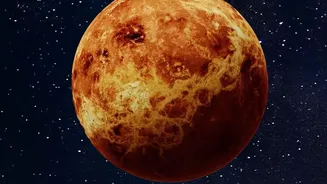
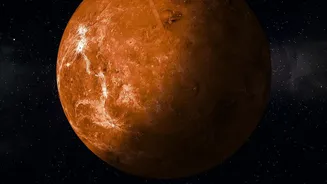
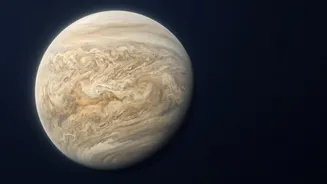
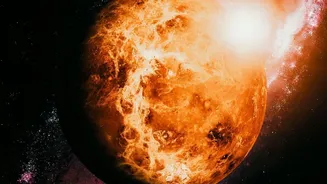
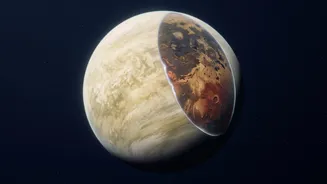
Venus and Earth are similar in size, mass, and density, suggesting they may have formed under similar conditions billions of years ago. Yet today, they could not be more different. Venus is the hottest planet in our solar system, with a surface temperature
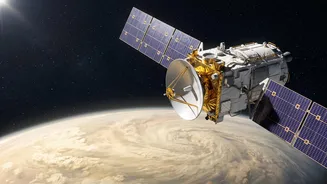
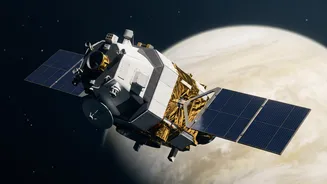
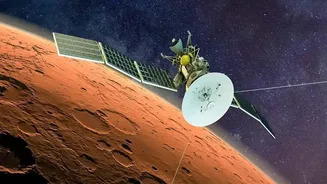
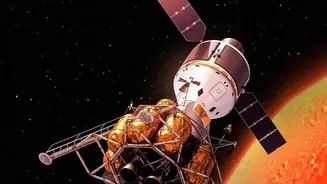
over 460°C and an atmospheric pressure 90 times that of Earth's. Its skies are filled with thick clouds of sulphuric acid. Scientists believe that understanding why Venus took such a dramatically different evolutionary path can provide critical insights into our own planet's climate and future. The Shukrayaan mission, officially called the Venus Orbiter Mission (VOM), was approved by the Indian Cabinet in September 2024 and aims to tackle these fundamental questions head-on.
Peering Through the Clouds with Radar
One of the biggest challenges in studying Venus is its thick, opaque cloud cover, which perpetually hides the surface from conventional cameras. To overcome this, Shukrayaan will be equipped with a powerful, high-resolution Synthetic Aperture Radar (SAR). This Indian-developed instrument works by sending radio waves through the clouds to the surface and analysing the returning echoes. Unlike a standard camera, SAR can operate day or night and in any weather. The goal is to create a detailed map of Venus's surface, searching for evidence of active volcanoes, lava flows, and other geological features with a resolution potentially four times greater than NASA's Magellan mission in the 1990s. This data will be crucial for understanding the processes that have shaped the planet's terrain over eons.
Probing the Subsurface for the First Time
In addition to mapping the surface, Shukrayaan aims to be the first mission ever to systematically study Venus's shallow subsurface. It will carry a ground-penetrating radar, an instrument designed to look for geological structures and layers of rock beneath the immediate surface. Similar instruments, like the SHARAD radar on Mars Reconnaissance Orbiter, have been instrumental in finding buried ice deposits on Mars. On Venus, this technology will help scientists investigate stratigraphy—the layering of rock—to build a history of the planet's geological past and understand how its crust has formed and changed, offering a three-dimensional view of its structure for the first time.
Analysing a Toxic and Turbulent Atmosphere
Much of the mission's focus will be on the chemical dynamics of Venus's dense atmosphere. A suite of instruments will be dedicated to this task. The Venus Thermal Camera (VTC) will map thermal emissions to study atmospheric dynamics, while the Venus Cloud Monitoring Camera (VCMC) will track cloud movements and potential lightning. One of the key international payloads is VIRAL (Venus InfraRed Atmospheric gases Linker), a collaborative instrument developed with Russia and France, which will study the composition of the atmosphere. Another crucial payload, developed in collaboration with Sweden, is the Venusian Neutrals Analyzer (VNA), which is part of an instrument called VISWAS. This sensor will study how the solar wind—a stream of charged particles from the Sun—interacts with the Venusian atmosphere, helping to explain how the planet has lost its atmospheric components over time.
A Testament to Indian Scientific Ambition
Scheduled for a launch in March 2028, Shukrayaan represents a major leap for the Indian Space Research Organisation (ISRO). Following the successes of Chandrayaan (Moon) and Mangalyaan (Mars), this mission positions India among the elite few nations to explore our nearest planetary neighbour. The development of sophisticated sensors like the high-resolution SAR and the ground-penetrating radar showcases India's growing self-reliance and technological prowess in planetary exploration. The mission will not only gather invaluable scientific data but will also test critical technologies like aerobraking—using atmospheric drag to adjust the spacecraft's orbit—for the first time in an ISRO mission, paving the way for even more complex interplanetary journeys in the future.