



Strengthen Your Geometric Base
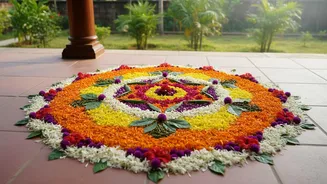
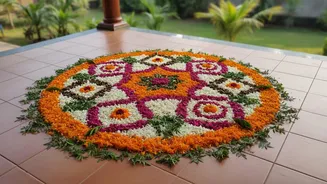
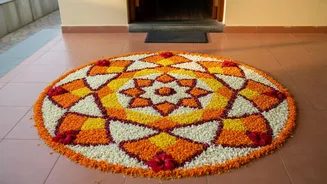
The secret to an impressive pookkalam lies not in the volume of flowers, but in its design. A strong, well-defined geometric pattern is the foundation of a traditional look. Before you lay a single petal, draw your design on the ground with chalk. Classic
shapes like circles, stars, or squares create a powerful visual structure. By focusing on symmetry and clean lines, even a sparsely filled design will look intentional and elegant. Start from the centre and work your way outwards, ensuring your pattern is balanced. A good design is a blueprint for beauty, guiding the eye and creating impact regardless of how many flowers you use.
Embrace the Power of Leaves
Traditionally, pookkalams are not just about flowers; greenery plays a vital role. Various leaves can be used to add volume, texture, and a rich green hue that makes other colours pop. Chop leaves like Tulsi (holy basil), mango leaves, or any lush green foliage from your garden into small pieces to fill larger sections of your design. This technique adds a different texture and is an authentic way to create a fuller-looking arrangement without relying solely on expensive petals. Leaves can form borders for your concentric circles or fill entire sections, providing a beautiful, natural, and cost-effective filler.
Get Creative with Natural Fillers
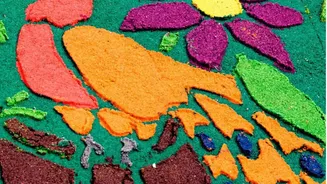
Think beyond flora. Many traditional pookkalams incorporate other natural materials to create texture and colour. Coloured rice, created by mixing rice with turmeric or other natural pigments, is a fantastic alternative for filling in sections of your design. Similarly, coloured sawdust or desiccated coconut can be used to achieve different textures and shades. These materials are not only budget-friendly but are also an eco-conscious choice. Some designs even incorporate pulses and grains, which can be gathered and used in the kitchen after the festival, embodying a spirit of zero waste. These elements add a rustic, earthy charm that is deeply rooted in the harvest traditions of Onam.
Focus on a Central Masterpiece
Instead of spreading your best flowers thinly across a large area, concentrate them in the centre of your pookkalam. Create a small, intricate, and flower-dense motif in the middle to serve as the focal point. This central design can feature more luxurious petals like roses or jasmine. For the outer rings, you can then use simpler, less expensive flowers, leaves, or the natural fillers mentioned earlier. This approach draws the eye to the most detailed part of your creation, giving the impression of richness and complexity, while the simpler outer layers provide scale and balance without demanding a large quantity of premium flowers.
Master the Art of Negative Space
Minimalism can be incredibly striking. A pookkalam does not need to be completely covered in petals to be beautiful. Some of the most elegant designs embrace 'negative space', using the floor itself as part of the visual composition. A delicate, spiralling pattern or a simple, large-scale outline of a flower with minimal filling can be just as impactful as a dense floral carpet. This approach shifts the focus from quantity to the gracefulness of the form itself. It’s a modern take that aligns perfectly with a desire for simplicity and sustainability while still honouring the artistic tradition of the pookkalam.
Colour Blocking for Maximum Impact
You don't need a dozen different types of flowers to create a vibrant pookkalam. Instead, focus on two or three contrasting colours and use them in bold, distinct blocks. For example, alternating thick rings of bright yellow marigolds and pure white jasmine petals can create a striking and clean look. This technique, known as colour blocking, simplifies the process and reduces the need to buy small quantities of many different flowers. The strong contrast between a few colours often has a more powerful visual effect than a busy mix of many, proving that a thoughtful colour palette is more important than the number of shades used.