




A New Window on the Cosmos
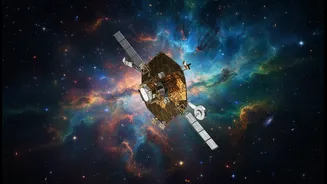
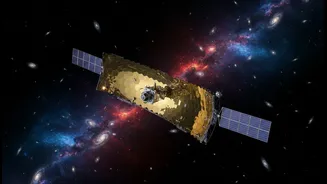
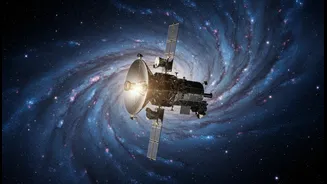
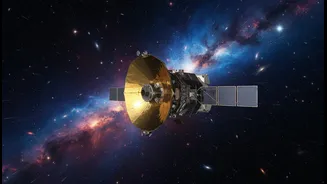
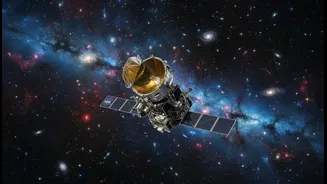
Set to launch aboard a Falcon Heavy rocket on August 30, 2026, the Nancy Grace Roman Space Telescope is NASA’s next great astrophysics observatory. Named after Nancy Grace Roman, NASA's first chief of astronomy and the 'Mother of Hubble', this mission
will survey the sky in infrared light to investigate some of the most profound puzzles in cosmology. While its mirror is the same size as the Hubble Space Telescope's at 2.4 meters, Roman's power lies in its extraordinary field of view. Its Wide Field Instrument will capture images 100 times larger than Hubble can, allowing it to map vast stretches of the universe with incredible speed and efficiency. This panoramic capability is what will enable it to hunt for answers to its primary science goals: understanding dark energy and discovering a vast census of exoplanets.
The Mystery of Dark Energy
One of the most perplexing discoveries of modern astronomy is that the expansion of the universe is accelerating. Scientists attribute this phenomenon to a mysterious force called dark energy, but they don't know what it is. Roman will tackle this enigma by mapping the universe's structure and measuring its expansion history with unprecedented precision. It will survey billions of galaxies and observe thousands of distant stellar explosions called supernovae, which serve as cosmic mile markers. By studying how the distribution of galaxies has evolved and how quickly they are moving away from us over cosmic time, astronomers hope to finally shed light on the nature of this dominant, yet invisible, component of our universe.
A Galactic Census of New Worlds
Beyond the grand scale of cosmology, Roman will also revolutionize the search for planets outside our solar system. Using a technique called gravitational microlensing, the telescope will monitor the brightness of hundreds of millions of stars toward the dense center of our Milky Way galaxy. When one star passes in front of another, its gravity can act like a lens, magnifying the light of the background star. If the foreground star has a planet, the planet's own gravity creates an additional, brief spike in brightness. This method is sensitive enough to find planets much smaller than those found by other techniques, including worlds with masses similar to Earth's. Scientists expect Roman to discover thousands of exoplanets this way, including potentially rogue planets that drift through space without a parent star.
More Than a Survey Machine
While Roman is designed as a wide-angle survey telescope, it will also feature a technology demonstration called the Coronagraph Instrument. This instrument is designed to block the overwhelming glare of a star, allowing for the direct imaging of the much fainter planets orbiting it. Seeing a planet directly is a major challenge, often compared to spotting a firefly next to a powerful searchlight. Roman's coronagraph will be a crucial testbed for technologies that could one day be used on future missions, like the planned Habitable Worlds Observatory, to directly image Earth-like planets and search their atmospheres for signs of life.
A New Era of Cosmic Discovery
Roman is not designed to replace other great observatories like the Hubble or James Webb Space Telescopes, but to complement them. Its strength lies in speed and scale, quickly identifying vast numbers of interesting targets across the sky. Webb can then perform deep, focused observations on specific planets or galaxies that Roman discovers, while Hubble can provide follow-up views in different wavelengths of light. By creating an enormous public data archive, Roman will provide a treasure trove for astronomers to mine for decades, enabling countless discoveries beyond its primary mission, from tracking asteroids in our own solar system to studying the growth of supermassive black holes. The sheer volume of information it gathers promises to reshape our understanding of the cosmos.