




An Accidental Journey to the Moon
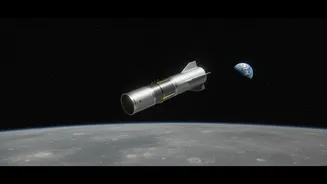
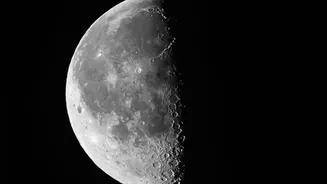
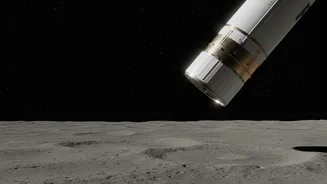
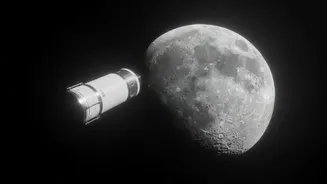
On March 4, 2022, a spent rocket booster collided with the far side of the Moon. This wasn't a planned mission, but the predictable end for a piece of space hardware left in a chaotic orbit. The object was the second stage of a rocket that launched the Deep
Space Climate Observatory (DSCOVR) in 2015. After deploying the satellite, the booster didn't have enough fuel to return to Earth's atmosphere or escape into deep space. Instead, it was captured by the Earth-Moon system's complex gravitational dance, making its eventual collision with the Moon inevitable. Astronomer Bill Gray was the first to calculate its trajectory, turning what could have been an unnoticed event into a moment of keen scientific interest. The impact itself happened on the far side of the Moon, out of sight from Earth-based telescopes.
A Unique Scientific Opportunity
While an accidental crash might sound like a messy affair, planetary scientists saw it as a valuable experiment. When an object hits the Moon, it kicks up material from beneath the surface, called ejecta. By studying this plume of dust and rock, scientists can learn about the composition of the lunar regolith (the Moon's soil) without having to land a mission and dig. This impact was a rare chance to study a fresh crater whose cause was known. Unlike ancient craters formed by asteroids of unknown size and speed, scientists knew the rocket stage's mass and velocity—around 4 tons hitting at over 9,000 km/h. This data provides a baseline to better understand the physics of high-velocity impacts, which helps in interpreting all craters, whether on the Moon or other planets.
The Surprise of a Double Crater
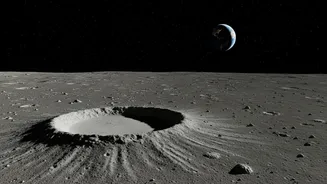
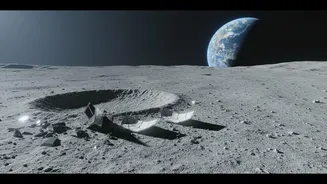
After the impact, NASA's Lunar Reconnaissance Orbiter (LRO) flew over the predicted site and found the aftermath. To everyone's surprise, it wasn't one crater, but two. The images revealed an 18-meter-wide crater overlapping a 16-meter-wide one. This was unexpected, as previous intentional impacts, like those from the Apollo program's S-IVB stages, had only created single, albeit sometimes irregular, craters. The double crater suggested that the rocket stage had a distinct, heavy mass at each end. Typically, a spent booster's mass is concentrated at the motor end. The unusual shape of the crater offered a clue about the impacting object's structure and mass distribution, sparking a debate about its exact identity, though it was later confirmed to be a Chinese rocket stage from a 2014 mission, not the initially suspected Falcon 9.
Lessons Learned From a Lunar Collision
This event was a powerful reminder that space is becoming an increasingly busy place. The unintentional impact highlighted the growing issue of space debris, not just in Earth's orbit but in the wider cislunar space between our planet and the Moon. Tracking this junk is difficult, and this rogue booster was a perfect example. However, the scientific value was undeniable. It served as a free, if accidental, version of missions like NASA's LCROSS, which deliberately crashed an impactor into the Moon in 2009 to search for water ice. By observing the plume and the resulting crater, scientists can refine their models of impact events. These models are crucial for understanding the history of the solar system and for planning future missions that might one day need to deflect a hazardous asteroid.