



Our Best Theory of Everything (Almost)
For the last half-century, our best explanation for the universe at its most fundamental level has been the Standard Model of particle physics. This theory is stunningly successful, describing the basic building blocks of matter (particles like quarks
and electrons) and three of the four fundamental forces that govern their interactions. It predicted the existence of the Higgs boson, which was triumphantly discovered in 2012, completing its roster of known particles. But for all its success, the Standard Model is incomplete. It has no explanation for gravity, the fourth fundamental force. Crucially, it also has nothing to say about two of the biggest components of our cosmos: dark matter and dark energy. Together, these mysterious substances make up about 95% of the universe, yet they don't fit anywhere in the model. These gaps are the 'unexplained physics' that keep cosmologists up at night, prompting them to look for clues in the most ancient light imaginable.
A Snapshot from the Infant Universe
That ancient light is the Cosmic Microwave Background (CMB). It’s essentially the afterglow of the Big Bang, a fossil radiation released when the universe was just 380,000 years old. In its infancy, the universe was a hot, dense, opaque fog of plasma. As it expanded and cooled, protons and electrons eventually combined to form the first atoms, allowing light to travel freely for the first time. That first light has been travelling across space for 13.8 billion years. Today, we detect it as a faint, uniform microwave glow in every direction we look. First discovered by accident in 1965, the CMB is considered rock-solid evidence for the Big Bang. By studying it, astronomers are essentially looking at a baby picture of the universe.
Searching for Cracks in the Cosmic Egg
According to the Standard Model, this 'baby picture' should be almost perfectly uniform, but with tiny, specific variations in temperature and polarisation—the orientation of light waves. These slight fluctuations are the seeds from which all cosmic structures, including galaxies, eventually grew. Missions like the COBE, WMAP, and Planck satellites have mapped these fluctuations with incredible precision. For the most part, the map looks just as predicted. But in recent years, scientists have noticed several persistent, large-scale anomalies—features that don't quite fit the standard theory. These include unexpected cold spots, a strange alignment in the patterns of temperature variations, and a slight deficit in the signal's strength at the largest scales. While any one of these could be a statistical fluke, their combined presence suggests something else might be going on.
Whispers of New Physics
So, what could these anomalies be telling us? One intriguing recent finding is 'cosmic birefringence', where the polarisation of the CMB light appears to have been slightly rotated on its long journey to Earth. This is not predicted by the Standard Model and could be a sign that the light has interacted with an unknown particle or force, possibly related to dark matter or dark energy. Other anomalies, like a large-scale dipolar modulation, challenge the core assumption that the universe is the same in all directions. While our motion through space accounts for most of this dipole, a small part of it might be primordial, hinting at a very different early universe than we imagined. These are not yet 'smoking gun' discoveries, but they are compelling breadcrumbs leading physicists toward a more complete theory.
The Next Generation of Cosmic Detectives
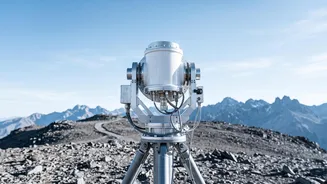
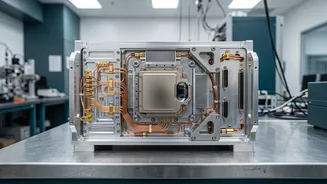
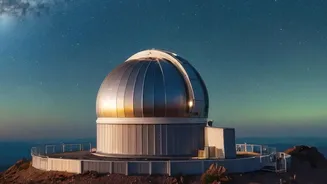
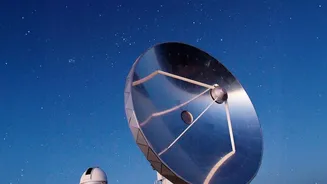
To find out if these anomalies are flukes or genuine discoveries, scientists need better data. The next stage of research is already underway. A massive international project called CMB-S4 will unite collaborations and use an array of 21 telescopes in Chile and at the South Pole. Fitted with half a million state-of-the-art detectors, it will survey the microwave sky with unprecedented sensitivity. The goal of CMB-S4 and other next-generation experiments is to create hyper-detailed maps of the CMB's polarisation. This will allow them to search for the faint signature of primordial gravitational waves from cosmic inflation—the theorised rapid expansion moments after the Big Bang. A definitive detection of these waves, or further confirmation of the strange anomalies, would revolutionize cosmology and provide the first concrete evidence of physics beyond the Standard Model.