


From Government Agency to Economic Engine
For decades, the Indian Space Research Organisation (ISRO) was the sole custodian of India's space ambitions. However, recent policy shifts have transformed it from a purely governmental body into a catalyst for a burgeoning private industry. The opening
of the space sector in 2020 and the establishment of the Indian National Space Promotion and Authorisation Centre (IN-SPACe) have been game-changers. IN-SPACe acts as a single-window agency to facilitate private companies, streamlining approvals and fostering collaboration. This has spurred the growth of a vibrant ecosystem, with projections showing India's space economy could reach $44 billion by 2033. This new landscape means ISRO now partners with and nurtures a new generation of space entrepreneurs.
The Startup Boom Creates New Roles
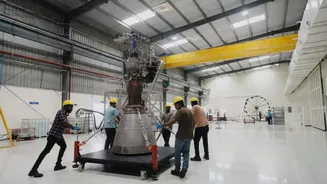
The most visible sign of this new ecosystem is the explosion of space-tech startups. Since 2020, over 400 private space companies have registered in India. Companies like Skyroot Aerospace, which is developing its Vikram-1 rocket, and Agnikul Cosmos, known for its 3D-printed rocket engines, are creating launch vehicles. Others, like Pixxel and SatSure, are focused on building satellite constellations for applications like hyperspectral imaging and climate analytics. This startup boom is generating thousands of new jobs. These companies are aggressively hiring for roles in propulsion, avionics, satellite systems, and mission control, offering competitive salaries and the chance to innovate rapidly.
Beyond the Engineering Blueprint
While engineering remains central, the expanding ecosystem demands a much wider range of skills. The data pouring down from satellites needs to be analysed, creating high demand for data scientists, geospatial analysts, and AI/ML specialists. These professionals interpret satellite imagery to support sectors like agriculture, urban planning, and disaster management. Furthermore, as space becomes a commercial frontier, new non-technical roles are becoming critical. The sector needs space lawyers to navigate complex international treaties, finance experts to manage venture capital funding for startups, and marketing and communications professionals to tell compelling stories. Even roles like public outreach specialists and education coordinators are emerging to bridge the gap between complex science and the public.
A New Spectrum of Technical Careers
Even within the technical domain, the required skill sets are diversifying beyond traditional aerospace and mechanical engineering. Materials scientists are crucial for developing advanced composites that can withstand the extreme conditions of space. Astrobiologists are involved in the search for life beyond Earth, a field of growing importance for future missions. The rise of satellite constellations and complex missions requires spacecraft operations engineers who can manage and monitor systems in orbit. Cybersecurity is another critical area, with experts needed to protect satellites and ground systems from potential threats. As missions become more autonomous, robotics engineers are also in high demand.
How to Enter This Expanding Universe
For those aspiring to join this dynamic field, the pathways are more varied than ever. While a strong foundation in STEM is still the most direct route into technical roles, it's no longer the only one. ISRO continues its direct recruitment for scientists, engineers, and a surprising number of administrative roles like assistants and clerks. Simultaneously, private companies like Dhruva Space are openly hiring for positions ranging from Legal Associates to Project Managers alongside their engineering teams. For students, internships and junior research fellow positions offer a foot in the door. For those in non-technical fields, developing domain knowledge of the space industry is key to unlocking opportunities in this exciting and rapidly growing sector.