





The Universe’s Ghostly Messengers
To understand the cosmos, we listen for its messengers. For centuries, this meant light. Today, we have new messengers: gravitational waves, cosmic rays, and the most elusive of all, neutrinos. Neutrinos are fundamental particles, often called 'ghost
particles', because they are nearly massless and have no electric charge. Produced in the heart of stars, supernovae, and other violent cosmic events, they travel for billions of years in a straight line, unimpeded by the planets, stars, and magnetic fields that deflect other particles. This makes them perfect, pristine messengers, carrying secrets directly from the core of the most extreme environments in the universe. The catch? They are incredibly difficult to detect precisely because they interact so weakly with matter. Hundreds of trillions pass through you every second, but maybe only one will ever interact with an atom in your body.
Introducing the 'Shadow Blaster' Idea
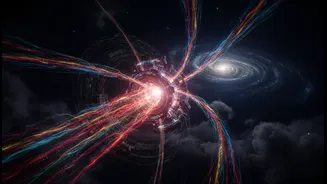
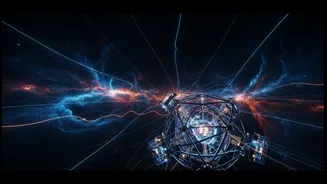
The term 'Shadow Blaster Neutrino Source' isn't a single machine, but a powerful concept representing the next generation of neutrino observatories. Think of projects like the IceCube Neutrino Observatory in Antarctica, which turned a cubic kilometre of pristine ice into a massive detector. These giant instruments don't 'blast' anything; instead, they patiently wait for the rare flash of light created when a high-energy neutrino happens to smash into an atom in the ice or water. For years, these detectors have successfully captured what is known as a 'diffuse flux' — a faint, continuous background glow of high-energy neutrinos coming from all directions in the sky. It is this aggregate 'shadow' of countless distant, unresolved sources that the headline refers to, a collective hum from the universe's most powerful events.
The Challenge: A Hum vs. A Siren
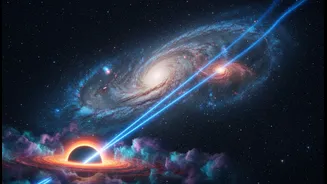
In astronomy, the gold standard for discovery is often identifying a 'point source' — for example, linking a specific signal to a single star, galaxy, or black hole. IceCube has had a few landmark successes, famously tracing a high-energy neutrino back to a flaring blazar (a galaxy powered by a supermassive black hole) called TXS 0506+056. But these are rare exceptions. The vast majority of detected cosmic neutrinos are part of the diffuse flux, their individual origins unknown. This is the central problem of 'single-source certainty'. It’s like hearing the low hum of a distant city; you know there is activity, but you can't distinguish the sound of a specific car or factory. The challenge for scientists is to figure out what they can learn from the overall hum, even if they can’t hear the individual sirens.
Finding Clues in the Crowd
This is where statistical analysis becomes a superpower. While we may not know where any single neutrino came from, we can analyse the properties of the entire collection. Scientists can map the neutrino 'glow' across the sky. Is it perfectly uniform, or is it slightly brighter in certain areas? They can study the energy distribution of these neutrinos. By correlating this statistical data with maps of known cosmic structures, such as clusters of galaxies or regions of intense star formation, patterns begin to emerge. For example, if the neutrino flux is slightly higher in directions where there are many active galactic nuclei, it provides strong evidence that these objects are a primary source of cosmic rays, which are intimately linked to neutrino production. This statistical approach allows scientists to test theories about galaxy evolution and the origins of cosmic rays on a population level, rather than on a source-by-source basis.
The Power of Multi-Messenger Astronomy
The true power of this approach is unleashed in multi-messenger astronomy, which combines data from neutrinos, gravitational waves, cosmic rays, and traditional light (photons). Even without a specific neutrino source, the overall 'neutrino weather' provides a vital piece of the puzzle. Imagine gravitational wave detectors signal the merger of two neutron stars. Telescopes can scan that region of the sky for light, while neutrino observatories check for any associated neutrino activity. Even a non-detection of neutrinos is scientifically valuable, as it helps constrain models of what happens in these extreme collisions. By combining these different, and often incomplete, signals, we can build a much richer, more robust understanding of the universe's most dramatic events than any single messenger could provide alone.