



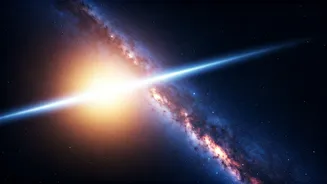


The Darkness Isn't Just a Backdrop
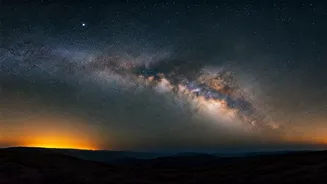
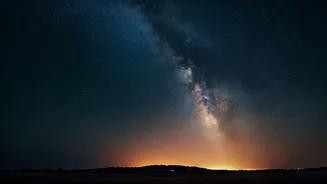
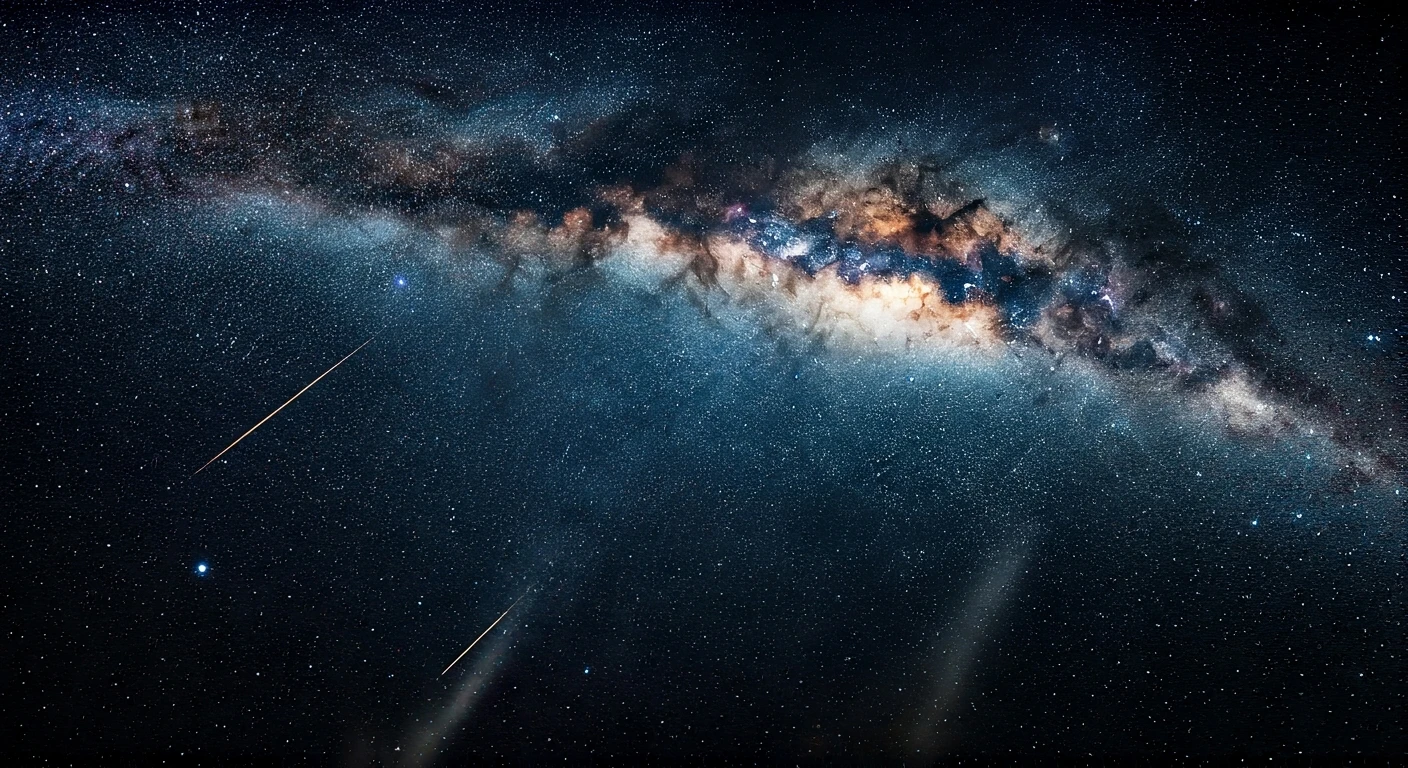
It’s easy to think of the blackness between stars as a simple, empty canvas upon which celestial objects are painted. But that darkness is not an absence of something; it is something. This is the interstellar medium (ISM), the vast expanse of space that exists
between the star systems within a galaxy. While it appears empty to our naked eyes, it is a place of immense scale and subtle activity. The distance between our Sun and its nearest neighbour, Proxima Centauri, is over four light-years—a journey that would take a conventional spacecraft tens of thousands of years. This entire journey is through the interstellar medium.
An Almost-Perfect Emptiness
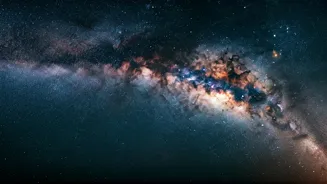
So, what exactly is in this 'gap'? The interstellar medium is an extremely low-density mix of gas (mostly hydrogen and helium), dust particles, and cosmic rays. If you were to cup your hands in the densest part of the ISM, you would only hold a few hundred atoms. Compare that to the trillions of atoms in a single breath of air on Earth. It is one of the most perfect vacuums known to science, far emptier than any vacuum we can create in a lab. Yet, over the vastness of a galaxy, this sparse material adds up. It is the raw ingredient from which new stars and planets are born. Nebulae, the beautiful clouds of gas and dust we see in telescope images, are simply the densest regions of the ISM, collapsing under their own gravity to ignite new suns.
Zooming Out: The Intergalactic Void
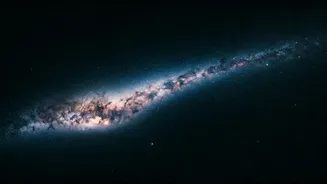
As mind-boggling as the scale of interstellar space is, it’s nothing compared to the next level up. The gaps between galaxies are known as intergalactic space, and they make the voids between stars look crowded. Our Milky Way galaxy is about 100,000 light-years across, but the distance to our nearest major galactic neighbour, Andromeda, is 2.5 million light-years. This chasm is filled with the intergalactic medium (IGM), which is even more rarefied than the ISM—up to a million times less dense. It is a ghostly soup of ionised hydrogen, containing the vast majority of the 'normal' matter (baryonic matter) in the universe. Astronomers believe these faint filaments of matter connect galaxies in a vast, web-like structure, often called the cosmic web.
The Great Cosmic Nothing
The largest gaps of all are the cosmic voids. These are the truly gargantuan regions of the universe, vast spherical expanses containing very few or no galaxies at all. If galaxies are cities and galaxy clusters are metropolitan regions, then voids are the colossal deserts separating them. The most famous example is the Boötes Void, sometimes called the 'Great Nothing.' Discovered in 1981, it is an astonishing 330 million light-years in diameter. If our Milky Way were at its centre, we wouldn't have known other galaxies existed until the 1960s. Scientists estimate that a space of this size should contain thousands of galaxies, yet it has only a few dozen. These voids are a fundamental part of the universe's structure, shaped by the gravitational pull of dark matter and pushed apart by the mysterious force of dark energy. They are a stark reminder that the universe is not uniformly filled but is instead a beautiful tapestry of dense filaments and near-total emptiness.