
The Universe's Tiny, Red Mystery
Ever since the James Webb Space Telescope (JWST) began sending back its breathtaking images, astronomers have been intrigued by a particular class of objects: tiny, faint, and distinctly red specks scattered across the cosmic dawn. Nicknamed 'Little Red
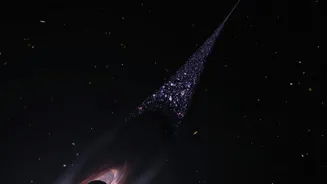
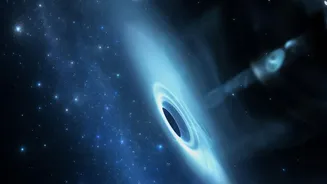
Dots' (LRDs), these objects appear to be from a time when the universe was only a few hundred million years old, a mere fraction of its current age. Their nature was a profound puzzle. Were they unusually dusty star-forming galaxies, or something else entirely? The leading theory quickly began to point toward something even more exotic: that these LRDs are the cores of active galaxies, each powered by a furiously growing supermassive black hole. These aren't just any black holes; they are behemoths that appear to have grown far bigger, far faster than our models of the early universe predicted was possible. The 'Little Red Dots' weren't just a curiosity; they were a challenge to our fundamental understanding of cosmic evolution.
A Crowded Cosmic Neighbourhood
The latest research has added a thrilling new layer to the mystery. By taking an even deeper look at the regions around these LRDs, astronomers have discovered they are not isolated loners. Instead, many of them are surrounded by a collection of smaller, fainter companion galaxies. The headline-making study reveals that one of these dots, a quasar hosting a rapidly growing black hole, resides in what scientists call an 'overdensity'—a region of space that is unusually crowded with other galaxies for that early epoch. This is a game-changing observation. It’s like discovering that a surprisingly large skyscraper in a remote village is actually the first building of a future metropolis. These companion galaxies, previously hidden from view, provide a crucial piece of the puzzle. They represent a rich source of gas and material that could be funneling into the central LRD, providing the very fuel needed for its supermassive black hole to grow at such an astonishing rate.
How Webb Uncovered the Secrets
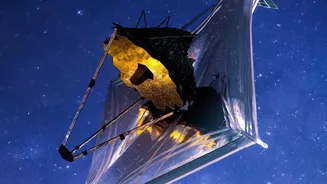
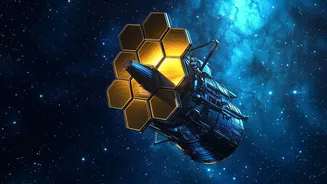
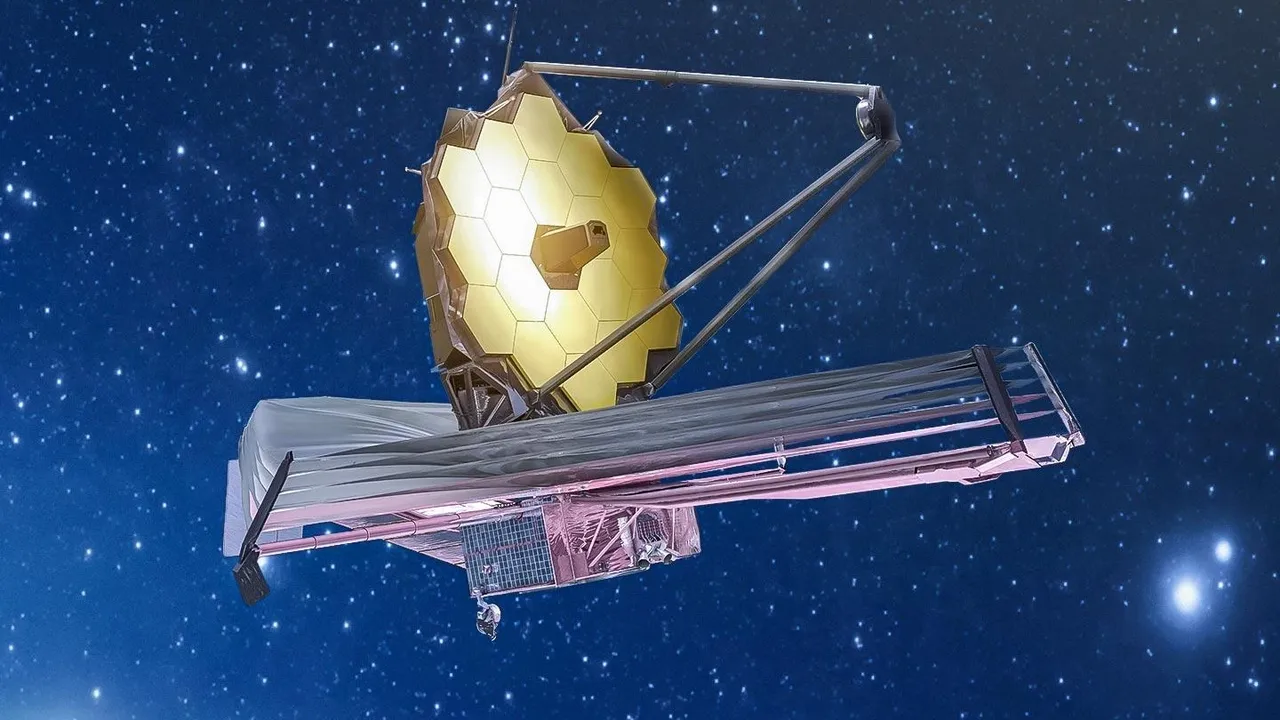
Finding these faint, hidden galaxies was a task only the James Webb Space Telescope could accomplish. Its unparalleled sensitivity and powerful infrared instruments allow it to peer back in time and through the cosmic dust that obscures our view of the early universe. Objects from this era are so distant that their light has been stretched into the infrared part of the spectrum by the expansion of the universe, making them invisible to older telescopes like Hubble. By using instruments like the Near-Infrared Camera (NIRCam), Webb can collect the faint glow from these primordial galaxies. For this particular study, astronomers spent dozens of hours staring at a single patch of sky, allowing the faint light from these companion galaxies to slowly build up into a detectable signal. The discovery showcases not just what Webb can see, but its ability to uncover the environments that shape the universe's most extreme objects.
Rewriting the Book on Black Holes
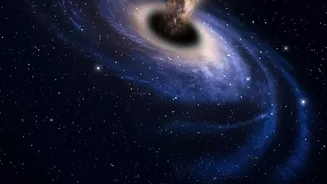
This discovery has profound implications for how we believe supermassive black holes—the cosmic engines that sit at the heart of nearly every large galaxy, including our own Milky Way—came to be. The existence of such massive black holes so early in cosmic history has been a major theoretical headache. How do you grow something millions or billions of times the mass of the Sun in such a short amount of time? The traditional model involves a slow-and-steady growth over billions of years. The new findings suggest an alternative, more dramatic path. It appears that in the chaotic, dense nurseries of the early universe, black holes could have been born in galaxy-rich environments that provided a constant, high-speed buffet of gas and stars for them to consume. This 'super-Eddington' accretion, where black holes feed faster than was thought theoretically possible, could be the key to their rapid growth. The 'Little Red Dots' and their newly found neighbours are providing the first observational evidence for this violent, accelerated path to becoming a giant.