
Seeing the Invisible
To understand the universe's dawn, you need a special kind of vision. The earliest stars and galaxies are not only incredibly far away, but they are also shrouded in thick clouds of cosmic gas and dust that visible light cannot penetrate. This is where
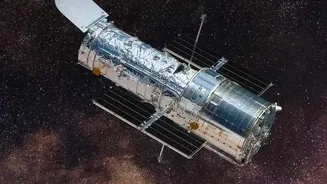
the James Webb Space Telescope (JWST), an international collaboration between NASA, the European Space Agency, and the Canadian Space Agency, changes the game. It is designed to see the universe in infrared light. This allows it to peer through the obscuring dust clouds, much like an X-ray sees through skin. Furthermore, because the universe is expanding, the light from the most distant objects gets stretched out during its journey across billions of years. Ultraviolet and visible light from the first stars is 'redshifted' all the way into the infrared spectrum by the time it reaches us. JWST’s infrared sensitivity means it can capture this ancient, stretched light, giving humanity its clearest view yet of the cosmic dawn.
Galaxies Older and Weirder Than Expected
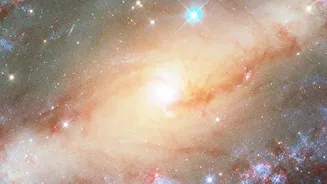
The secrets revealed by JWST's deep-field images are already challenging long-held theories. Astronomers are discovering galaxies that are far more mature and structured than models predicted for that early epoch. Recent observations have identified massive spiral galaxies that were already well-organized when the universe was less than two billion years old, a level of maturity that was thought to take much longer to achieve. These findings suggest that the process of galaxy formation may have been much faster and more efficient than previously believed. In some cases, JWST's data has allowed scientists to recalculate the ages of known galaxies, pushing their origins back to within just 300 to 450 million years after the Big Bang. This places them firmly in the first wave of galaxies to ever form, forcing a rethink of the timeline for cosmic evolution.
The Hidden Engines of Creation
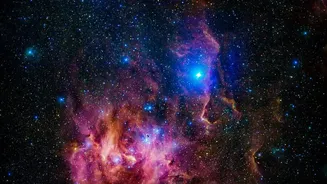
One of the most profound secrets being uncovered is the sheer intensity of early star birth. The JWST is showing that star formation in the young universe was potentially far more dramatic and luminous than it is today. Some theories suggest this could be because the first stars were composed almost purely of hydrogen and helium, the elements created in the Big Bang. Without the heavier elements that cool modern star-forming clouds, the primordial clouds may have formed stars that were much more massive and brilliant than those in our own Milky Way. Recent studies have also found that early galaxies may contain a much higher proportion of small, faint stars than previously accounted for, suggesting their total mass could be far greater than we knew. These 'hidden stars,' invisible to previous telescopes, are now being revealed by JWST, adding another layer of complexity to the story of galactic growth.
Cosmic Collisions and Furious Births
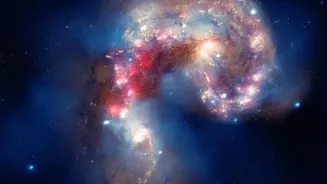
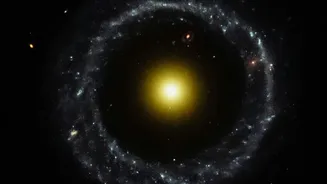
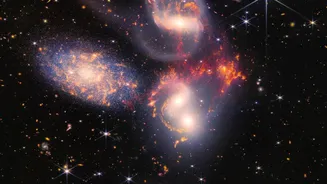
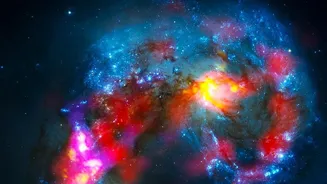
The early universe was a chaotic place, and JWST is providing a front-row seat to the violent events that shaped it. New images show how galactic collisions, which were more common in the crowded early cosmos, could trigger furious episodes of star formation. In so-called 'starburst' galaxies, the rate of star birth is so rapid that it quickly uses up the available gas and dust. By observing these galaxies in infrared, astronomers can pierce through the dust to see the powerful galactic winds and shockwaves from collisions that spark these creative frenzies. For example, stunning images of the Cartwheel Galaxy and Arp 263 show how the gravitational chaos of a galactic merger creates rings of fire, where dense clouds of gas collapse to form brilliant new stellar nurseries. This helps explain how some galaxies lived fast and died young, burning through their fuel in a spectacular, short-lived blaze of glory.