

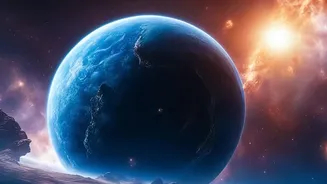
The 'Goldilocks' Habitable Zone
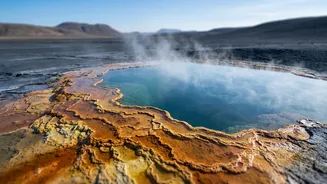
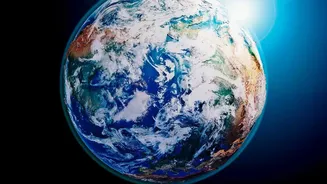
The most fundamental requirement for an Earth-like planet is its location. It must orbit its star within the 'habitable zone', often called the 'Goldilocks Zone'. This is the orbital region where conditions are not too hot and not too cold, but just right
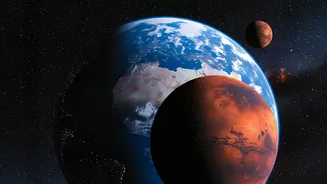
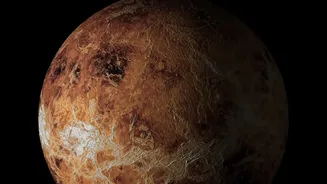
for liquid water to exist on the planet's surface. Liquid water is considered by scientists to be a fundamental ingredient for life as we know it. If a planet is too close to its star, its oceans will boil away, as likely happened on Venus. If it's too far, its water will freeze solid, like on Mars today. The exact boundaries of this zone depend on the star's size and temperature; a cooler, dimmer star like a red dwarf will have a habitable zone much closer to it than a hot, bright star like our Sun.
Size, Mass, and Rocky Composition
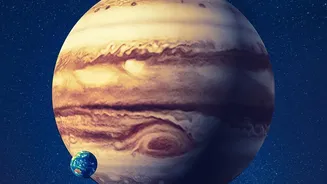
An Earth-twin can't be a gas giant like Jupiter. It must be a terrestrial, or rocky, planet. This provides a solid surface where life could potentially develop. Size and mass are also crucial. A planet that is too small, like Mars, has weaker gravity and struggles to hold onto a substantial atmosphere, which can be stripped away by stellar winds. A planet that is significantly larger and more massive than Earth (a 'Super-Earth') might have a crushing gravitational pull and a thick, dense atmosphere that could create a runaway greenhouse effect. Scientists look for planets with a radius and mass similar to Earth's, as this suggests a rocky composition and the ability to retain a life-friendly atmosphere.
A Stable and Well-Behaved Star
The planet itself is only half the story; the parent star it orbits plays a vital role. The ideal star is stable and long-lived, like our Sun, which is a G-type star. This stability provides a consistent energy source over billions of years, allowing ample time for complex life to potentially evolve. Many stars, particularly younger and smaller M-dwarf (red dwarf) stars, can be volatile. They often unleash powerful flares of radiation that could strip a nearby planet of its atmosphere and bathe its surface in sterilizing X-rays and UV rays, making it inhospitable. Therefore, the search for habitable worlds often focuses on planets orbiting stable stars that aren't prone to violent outbursts.
The All-Important Atmosphere
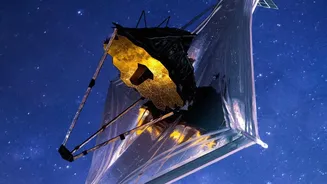
Having an atmosphere is critical for several reasons. It helps regulate a planet's temperature, provides protection from harmful solar and cosmic radiation, and creates the pressure needed to maintain liquid water on the surface. But beyond just having an atmosphere, its composition is key. Using advanced tools like the James Webb Space Telescope, astronomers can analyse the light passing through an exoplanet's atmosphere to look for 'biosignatures'. These are gases like oxygen, methane, and water vapour that, in certain combinations, could indicate the presence of biological processes. While finding these gases isn't definitive proof of life, it's a major sign that a planet is not just habitable, but potentially inhabited.
A Protective Magnetic Field and Geology
Other, more complex factors also contribute to Earth's long-term habitability. Our planet has a strong magnetic field, generated by its molten iron core, which acts as a shield against the Sun's harmful solar wind. Without this magnetosphere, the solar wind would gradually erode our atmosphere. Furthermore, Earth's active plate tectonics play a crucial role as a planetary thermostat. This geological process recycles carbon between the atmosphere and the planet's interior, helping to regulate the climate over geological timescales and preventing a runaway greenhouse or deep-freeze scenario. While these features are incredibly difficult to detect from light-years away, they are considered important pieces of the puzzle in what makes a planet truly Earth-like.