








A High-Stakes House Call
On Tuesday, August 25, NASA astronaut Anil Menon and European Space Agency (ESA) astronaut Sophie Adenot floated outside the International Space Station (ISS) for a crucial task. For six and a half hours, they worked meticulously in the vacuum of space
to install a new high-speed data antenna. This mission, officially known as U.S. Spacewalk 98, was the culmination of a two-part repair effort. A week prior, on August 18, the pair had successfully removed the faulty antenna but ran out of time to install its replacement due to the complexity of the work. This follow-up spacewalk saw them retrieve the spare from an external storage platform, carefully mount it, and connect the vital power and data cables that bring it to life. With the new hardware in place, they then secured the broken unit for permanent storage on the station's truss structure. The successful operation was the third spacewalk for Menon and the second for Adenot, who had previously made history as the first French woman to perform an extravehicular activity (EVA).
The Station's Lifeline to Earth
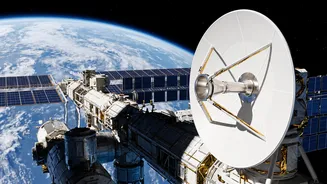
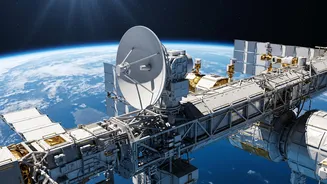
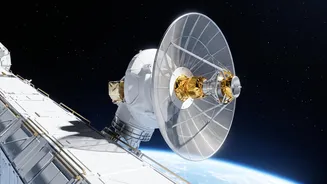
The hardware at the center of this spacewalk was a Space-to-Ground Antenna (SGANT), a key component of the station's S-band communications system. Think of it as the ISS's primary internet router and phone line combined. This system is the main conduit for almost all communication between the 400-kilometer-high laboratory and Mission Control in Houston. It handles everything from the crew's voice calls with family and flight controllers to the terabytes of scientific data beamed down from experiments. It also transmits crucial telemetry—the constant stream of health and status updates for the station's myriad systems—and the high-definition video feeds that allow us to see inside and outside the station. When the original antenna stopped working correctly last November, the station relied on a backup, losing critical redundancy. This repair has now restored the robust, two-antenna system that ensures this vital link remains stable and reliable.
A Delicate Dance in Zero Gravity
Performing such a repair is far from simple. Spacewalks are among the most physically and mentally demanding tasks an astronaut can undertake. Encased in bulky, pressurized suits, astronauts must work with precision while contending with the unforgiving environment of space. Every movement is deliberate, every tool tethered to prevent it from floating away and becoming a dangerous piece of orbital debris. For this task, Menon was positioned at the end of the 17-meter-long Canadarm2 robotic arm, which maneuvered him and the large antenna into place, while Adenot translated along the station's exterior using handrails. They had to carefully disconnect and reconnect cables and bolts, work that proved challenging even for experienced spacewalkers. The entire six-and-a-half-hour operation was a carefully choreographed ballet of human skill and robotic assistance, all to ensure a piece of critical infrastructure could be replaced safely.
Keeping the Science Flowing
The reliability of the station's data links is directly tied to its primary purpose: serving as a world-class scientific laboratory in microgravity. Hundreds of experiments are running on the ISS at any given time, managed by researchers from all over the world. These investigations cover everything from human health and materials science to Earth observation and fundamental physics. The data from these experiments is constantly streamed back to Earth for analysis, and a high-bandwidth connection is essential for that process. Without this reliable data flow, the scientific return on the massive investment in the ISS would be severely compromised. By successfully replacing the antenna, Menon and Adenot didn't just fix a piece of hardware; they ensured that the critical science enabling future exploration and benefiting life on Earth can continue without interruption. This seemingly routine maintenance is what makes groundbreaking discovery possible.