





The Enduring Mystery of the Northern Hexagon
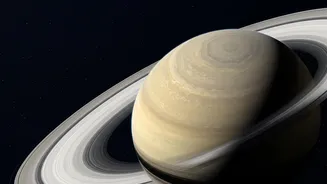
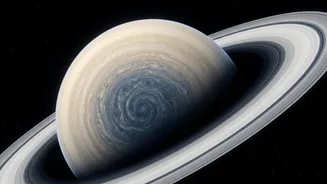
For over forty years, since it was first spotted by the Voyager spacecraft in the 1980s, Saturn's north pole has been home to a meteorological marvel: a colossal, six-sided jet stream. This feature, simply known as “the hexagon,” is a persistent wave
in the atmosphere wide enough to fit two Earths inside. It's a standing wave pattern created by powerful winds and the planet's rapid rotation. What makes the hexagon so remarkable is its stability; it rotates at nearly the same rate as the planet itself and has remained a fixture for the decades we’ve been watching. This long-term stability led scientists to wonder if a similar, symmetrical feature might exist at the planet's opposite pole. For years, the answer appeared to be no.
A New Ten-Sided Puzzle Emerges
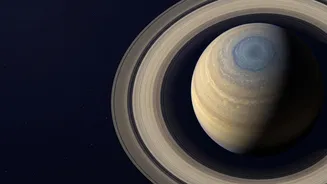
Thanks to Saturn's long seasons and axial tilt, its south pole was largely hidden from Earth's view for about a decade. When the pole came back into view around 2023, observations from NASA's Hubble Space Telescope, spurred by findings from amateur astronomers, revealed something new and unexpected. A massive, 10-sided atmospheric wave—a decagon—had begun to form. This marks the first time such a large, regular-sided jet pattern has been seen in the southern hemisphere. Analysis shows the decagon is not just a surface-level cloud pattern but a deep structure that extends through multiple layers of the atmosphere, much like its northern counterpart.
The Crucial Difference: Stability vs. Evolution
This is where the story gets truly interesting. While the northern hexagon is a picture of stability, the southern decagon is a construction site. Unlike the rigid, 40-year-old hexagon, the new decagon appears to be actively evolving and strengthening. Hubble observations between 2023 and 2025 show the 10-sided shape becoming more defined over time. Some of its sides appear crisp, while others remain diffuse, suggesting it is still assembling itself. Furthermore, its vertices oscillate, unlike the locked-in corners of the hexagon. This dynamism gives scientists a rare and precious opportunity: to watch a massive planetary weather system form and develop in real time, something the hexagon's permanence has never allowed.
Unlocking Secrets of Giant Planets
The contrast between the two poles offers a rich field for scientific inquiry. The difference between a six-sided and a ten-sided wave points to different conditions in the underlying jet streams in each hemisphere, such as their width, speed, and shear. Scientists are exploring several theories for why the decagon formed now. One idea is that it could be linked to seasonal changes after the south pole's long summer, or it might have been kicked into existence by a nearby high-pressure vortex. By studying why one pole hosts a stable hexagon and the other a developing decagon, researchers can refine their models of atmospheric dynamics on gas giants. This work doesn't just help us understand Saturn; it provides crucial insights into the weather and physics of planets far beyond our own solar system.