







A Planet with a Dramatic Arc
Discovered in 2001, HD 80606 b is a giant planet, about four times the mass of our own Jupiter. It orbits a star similar to our sun in the constellation Ursa Major. While thousands of exoplanets have been found, this one stands out because of its orbit.
Instead of a nearly circular path like the planets in our solar system, HD 80606 b follows a perilously elongated, or eccentric, route. Its 111-day year is less of a gentle loop and more of a terrifying plunge. For most of this time, the planet travels far from its star, in the cold, dark expanse of space. Then, its path brings it in for a brutally close and fast encounter with its parent star before flinging it back out again. This cometary-style orbit is one of the most extreme ever discovered.
The Fiery Climax
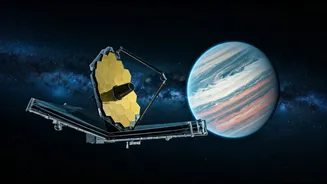
The real drama happens during the brief, frantic portion of its orbit when the planet swings incredibly close to its star—many times closer than Mercury is to our sun. In just a matter of hours, the planet is subjected to an almost unimaginable blast of energy. Observations from NASA's Spitzer and James Webb Space Telescopes have measured the effect of this 'flash-heating'. As it makes its closest approach, the temperature on the side of the planet facing the star skyrockets. In just six hours, the temperature can climb from about 527 degrees Celsius to over 1,227 degrees Celsius. Recent observations suggest the temperature swing could be even more dramatic, rising by 600 degrees Celsius (about 1,100 degrees Fahrenheit) as it gets roasted.
An Atmosphere at War
This sudden, violent heating does incredible things to the planet's atmosphere. Scientists have created models based on the thermal data, and they paint a truly cinematic picture of chaos. The intense energy blast is thought to trigger massive shockwaves that explode across the planet. These atmospheric tsunamis are followed by howling, supersonic winds estimated to move at over 11,000 miles per hour, or about 5 kilometers per second. An observer, if they could somehow survive above the clouds, would see the star swell to 30 times the apparent size of our sun in the sky. The entire atmosphere erupts into a global storm system that rages as the planet is cooked, then gradually subsides as it retreats back into the cold.
The Plot Twist
For years, astronomers believed planets like HD 80606 b were in a transitional phase. The theory was that such a planet started far out, was knocked into an eccentric orbit by a gravitational nudge, and would eventually be squeezed by its star's gravity into a tight, circular orbit—becoming a more typical 'hot Jupiter'. But newer observations suggest HD 80606 b isn't settling down as quickly as predicted. The planet seems to be less 'squishy' than expected, meaning the process of circularizing its orbit is happening much slower than theories suggested. It may maintain its violently eccentric path for another 10 billion years or more, destined to repeat its dramatic climax every 111 days.
Why This Cosmic Movie Matters
Studying a world like HD 80606 b is more than just cosmic sightseeing. It's a natural laboratory for testing the limits of atmospheric physics and planetary science. As one scientist noted, its extreme nature makes it a perfect target. The radical swings in temperature and chemistry allow researchers to gather data under a huge range of conditions in just a few hours. This helps them understand how atmospheres on other worlds, including more conventional ones, might behave. It challenges our assumptions about how planetary systems form and evolve, reminding us that our relatively calm and orderly solar system might be the exception, not the rule. Each observation of this distant world adds another scene to a story that proves science is often stranger, and more spectacular, than fiction.