




A Galaxy's Scars Revealed
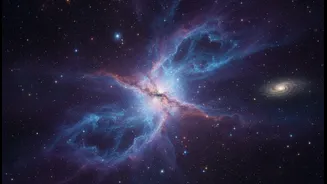
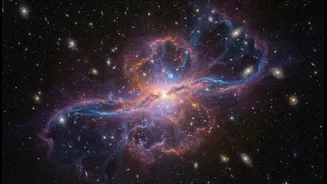
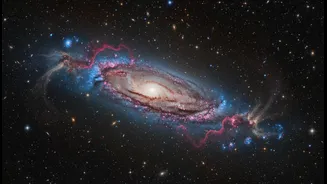
To mark its fourth year of science operations, the James Webb Space Telescope (JWST) has unveiled a spectacular new view of Centaurus A. Located a relatively close 11 million light-years away, this galaxy is a cosmic puzzle. It has a strange, distorted
shape because it's the result of a massive galactic collision that happened about two billion years ago. Webb's powerful infrared vision cuts through the thick dust that usually hides the galaxy's core, revealing millions of individual stars. Astronomers describe studying this image as a form of 'galactic archaeology,' where each star provides a clue to the galaxy's violent and active past, including the behaviour of the supermassive black hole at its heart. The new image shows a warped, parallelogram-like band of dust and a mysterious S-shaped feature that scientists are now working to understand.
A Crimson Nursery of Stars
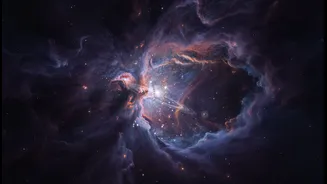
The Hubble Space Telescope, a veteran of cosmic observation, recently captured a breathtaking image of a stellar nursery known as LH 95. Located in the Large Magellanic Cloud, a small satellite galaxy orbiting our own Milky Way, this region is a bustling hub of star formation. The image is a celestial fireworks display, with brilliant blue and white stars sparkling against a backdrop of crimson-glowing hydrogen gas. The most massive blue stars are so powerful they blast out radiation and stellar winds, sculpting the surrounding gas clouds. But the image also reveals about 2,500 smaller, infant stars that are still growing, pulling in gas and dust. This provides scientists with a unique opportunity to study how multiple generations of stars can exist and form side-by-side.
The Dazzling Heart of the Milky Way
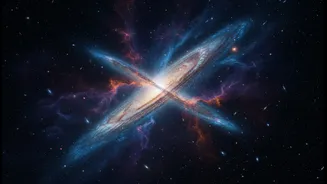
ESA’s Euclid mission, usually tasked with mapping the dark universe, took a special detour to photograph the heart of our own Milky Way galaxy. The result is the largest, most detailed high-resolution photo ever taken of our galaxy's center in visible light, containing an estimated 60 million stars. This incredibly dense region, known as the galactic bulge, is so crowded that distinguishing individual stars is a major challenge, but one Euclid handled perfectly. While its main goal is studying dark matter, this image will serve another purpose: helping astronomers search for and measure the mass of exoplanets using a technique called microlensing, where a foreground star acts like a cosmic magnifying glass for a star behind it.
A Star-Spangled Cluster
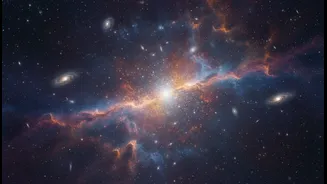
In another recent release, the Hubble telescope shared a stunning image of the globular cluster NGC 6426 to celebrate the United States' 250th anniversary. The image is filled with stars that glitter in red, white, and blue hues, resembling a sparkler against the dark void of space. Globular clusters are dense, spherical collections of ancient stars all born around the same time from the same cloud of gas. At an estimated 13 billion years old, NGC 6426 is one of the oldest such clusters in the Milky Way, forming not long after the universe itself began. By studying the ages and chemical compositions of these ancient star systems, astronomers can piece together the history of how our own galaxy formed and evolved.