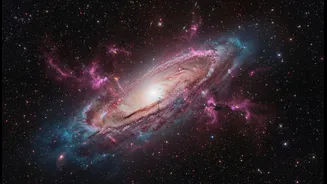






A Familiar Cosmic Giant
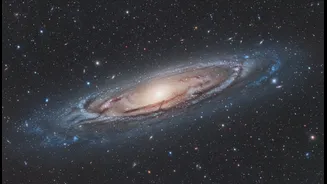
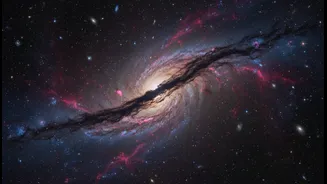
For over a century, astronomers have been captivated by Centaurus A. Located a relatively close 11 million light-years away, it is one of the brightest and most unusual galaxies in our night sky. From Earth, it famously appears as a brilliant sphere of stars
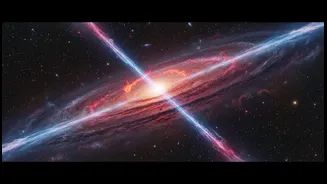
sliced in half by a thick, dark lane of cosmic dust. This peculiar structure is the result of a violent past; roughly two billion years ago, Centaurus A collided with and consumed a smaller spiral galaxy. This cosmic merger left it with an active supermassive black hole at its core, which spews out powerful jets of energy, and a chaotic mix of gas and dust that fuels intense bursts of star formation. Because of this activity and its proximity, it serves as a perfect natural laboratory for understanding how galaxies evolve.
Peering Through the Dust
While astronomers knew Centaurus A was dynamic, its dense dust clouds have long hidden the secrets of its core. Telescopes like Hubble, which see in visible light, were unable to penetrate the thick shroud. Even earlier infrared observatories like Spitzer could see large-scale structures but lacked the sharpness to resolve fine details. Now, stunning new images captured by the James Webb Space Telescope (JWST) have changed everything. To mark its fourth year of operations, NASA released images that use Webb's powerful infrared instruments to cut through the dust, uncovering the galaxy's innermost regions with breathtaking clarity.
Hidden Structures Revealed
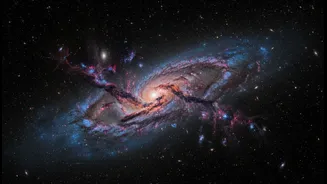
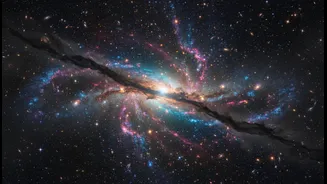
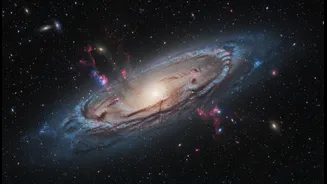
The new Webb images reveal a complex and delicate network of structures never seen before. What once looked like a hazy glow is now resolved into a dense field of millions of individual stars. Most striking are the intricate filaments and glowing clouds of warm dust. Webb’s Mid-Infrared Instrument (MIRI) highlights a mysterious S-shaped structure near the core and a warped, parallelogram-like band of dust crossing the galaxy's centre. These bizarre shapes are the new “layers” that have astronomers buzzing. They are the intricate scars of the galaxy's past collision and provide a fossil record of how the galaxy's central black hole interacts with its surroundings. The glowing reddish-purple dots scattered throughout are stellar nurseries, where new stars are being born from the recycled material of older, dying stars.
Why These New Layers Matter
These discoveries are more than just pretty pictures; they provide crucial data for understanding one of the biggest questions in astronomy: how do galaxies and their central black holes grow and evolve together? The S-shaped feature and warped dust lanes pose new questions about whether they were formed by the ancient merger or are currently being sculpted by the powerful jets from the black hole. By studying Centaurus A star by star, scientists can now perform a kind of 'galactic archaeology', creating a timeline of its evolution. Webb can also analyze the light to measure how gas moves, revealing material flowing outward from the black hole while other gas rotates nearby. This gives astronomers a front-row seat to the complex interplay where a black hole can both trigger star formation by compressing gas and shut it down by blasting material away.