





Artemis Program: A Return to the Moon, Together
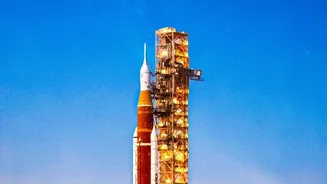
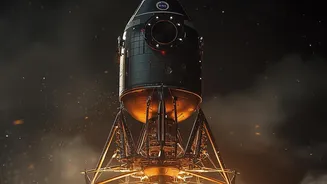
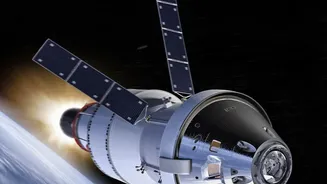
The Artemis program is NASA's ambitious plan to establish a long-term human presence on the Moon, and it has a distinctly international flavour. In August 2026, NASA officially invited ISRO to participate in its planned Moon Base near the lunar south
pole. This comes after India became a signatory to the Artemis Accords in 2023, a set of principles for peaceful and sustainable lunar exploration. For India, this is a significant opportunity. With its own goals of a human moon landing by 2040 and the success of the Chandrayaan missions, collaborating on Artemis could provide access to new technologies and fast-track its own human spaceflight ambitions. It solidifies the nation's role not just as a space-faring power, but as a key partner in humanity’s next giant leap.
NISAR: A Joint Eye on Planet Earth
Arguably the most direct and significant collaboration between the two space agencies is the NISAR (NASA-ISRO Synthetic Aperture Radar) mission. Launched in July 2025, this joint Earth-observing satellite is a shining example of the India-US space partnership. NISAR is the first satellite imaging mission to use two different radar frequencies (L-band and S-band) and is designed to observe and measure some of the planet's most complex processes. Provisional data from the mission became available in July 2026. For India, NISAR is a game-changer for disaster management, agricultural monitoring, and understanding climate change impacts. It will provide incredibly detailed data on everything from volcanic eruptions and earthquakes to the health of our forests and glaciers, making it a vital tool for the nation's scientists and policymakers.
Europa Clipper: The Search for Alien Oceans
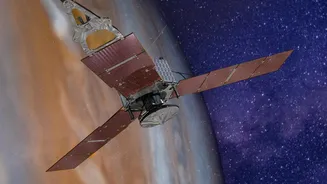
Beyond our immediate neighbourhood, NASA's Europa Clipper is on a long journey to investigate one of the most tantalising questions in our solar system: could Jupiter's moon Europa harbour life? Launched in October 2024, the spacecraft is headed for Jupiter's orbit to perform dozens of close flybys of the icy moon, which is believed to hide a vast saltwater ocean beneath its surface. For Indian readers, this mission represents the pinnacle of pure scientific exploration. As of late 2026, the Clipper is on course for a crucial Earth gravity assist in December, which will slingshot it towards the outer solar system for its 2030 arrival. While ISRO focuses on missions to the Moon, Mars, and Venus, Europa Clipper is a reminder of the bigger cosmic questions that unite scientists globally. Its findings on the potential habitability of another world will be followed closely by researchers and stargazers across India.
Mars Exploration's Next Chapter
India's Mangalyaan mission was a landmark achievement, making it one of the few nations to successfully reach Martian orbit. While NASA's ambitious Mars Sample Return (MSR) program, which aimed to bring back rocks collected by the Perseverance rover, was reset due to budget and timeline concerns, the quest continues. NASA is currently evaluating new, more cost-effective strategies for returning the samples, with a final decision on the new mission design expected in the latter half of 2026. This evolution is important for India to watch. As ISRO plans its own future robotic missions, the lessons learned from NASA's MSR redesign could inform India's approach to complex interplanetary exploration. The samples collected by Perseverance are still waiting on Mars, and the global scientific community, including India's, eagerly awaits the plan to finally bring them home for analysis.