



The Cosmic Speed Limit
To understand why starlight is history, we first need to talk about speed. Light is the fastest thing in the universe, zipping along at a staggering 3,00,000 kilometres per second. It’s so fast that a beam of light could circle the Earth more than seven
times in a single second. But even at this incredible velocity, space is so vast that the journey from a star to your eyes takes time—a lot of time. Astronomers measure these immense distances in light-years. A light-year isn't a measure of time, but of distance: it’s how far light travels in one year. That’s roughly 9.5 trillion kilometres. So, when we say a star is 10 light-years away, it means the light from that star has been travelling through the void of space for 10 years to reach us.
Your Sky Is a Time Machine
This is where things get truly mind-bending. Because the light takes so long to arrive, you are not seeing the star as it is *right now*. You are seeing it as it was when the light first began its journey. The star you see is a snapshot from the past. Every single star in the night sky is an echo, a glimpse into cosmic history.
Think about it this way: if someone on a star 10 light-years away had a telescope powerful enough to see you, they wouldn’t see you as you are today. They would see you as you were 10 years ago. In the same way, the image of that star you see tonight is a 10-year-old portrait.
A Tour of Your Night Sky’s History
Let’s make this personal with some famous stars you can see from India. Sirius, the brightest star in our night sky, is about 8.6 light-years away. The light you see from Sirius tonight left the star around 2015. It has been travelling through space during the entire tenure of some governments and the rise of today's biggest social media platforms.
Look towards the constellation of Orion to find Betelgeuse, a giant red star. It’s about 640 light-years away. The light we see from it tonight began its journey around the year 1384, during the time of the Delhi Sultanate. The light from Polaris, the North Star, left its source over 300 years ago, around the time the Mughal Empire was in its final stages. You are literally looking at light from another era of Indian history.
What If a Star Is Already Gone?
This concept leads to a startling possibility. A star could have already died, perhaps exploding in a magnificent supernova, and we would have no idea. Betelgeuse, for example, is a star nearing the end of its life. It could have exploded 100 years ago, 300 years ago, or just yesterday. But since it’s 640 light-years away, we wouldn't see the explosion until the light from that event finally reaches us, 640 years after it happened. For the next few centuries, we will continue to see a star that may no longer exist.
This isn't just theoretical. In 2008, astronomers observed a supernova. They later determined the star that exploded was 88 million light-years away, meaning the explosion actually happened 88 million years ago, when dinosaurs still roamed the Earth. The light from its death took all that time to reach our telescopes.
Beyond Stars to Ancient Galaxies
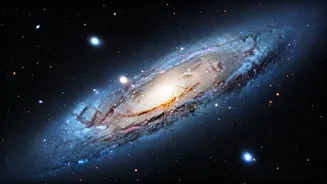
The effect is even more profound when we look beyond our own galaxy. The Andromeda Galaxy is the closest major galaxy to our own Milky Way and is visible to the naked eye as a faint, fuzzy patch on a very dark night. It is 2.5 million light-years away. The light you see from Andromeda tonight left before modern humans, Homo sapiens, even existed on Earth. You are witnessing light that is older than our entire species. The night sky is not just a canvas of stars; it's the deepest museum you could ever visit.