



A Sky Full of Hazards
Our solar system is filled with rocky leftovers from its formation over four billion years ago. Most of these asteroids orbit harmlessly in the main belt between Mars and Jupiter. However, the gravitational pull of planets can nudge them into orbits that
bring them close to Earth. These are known as near-Earth objects, or NEOs. As of early 2026, astronomers have discovered over 40,000 such asteroids. While most are small, some are large enough to cause significant damage if they were to impact our planet. The goal of planetary defense, a field managed by NASA's Planetary Defense Coordination Office (PDCO), is to find these objects long before they become a threat. The first step in this global effort is a relentless, automated search.
The Automated Watchers
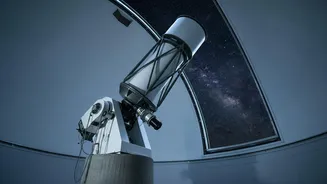
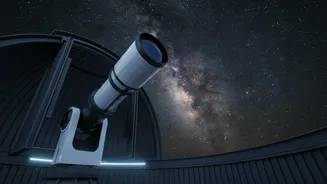
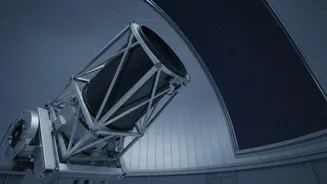
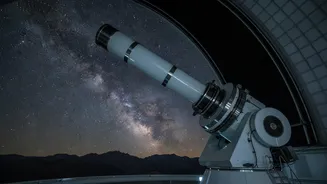
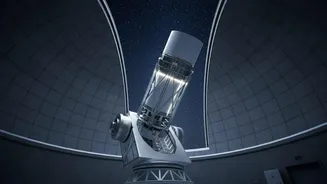
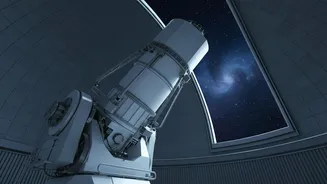
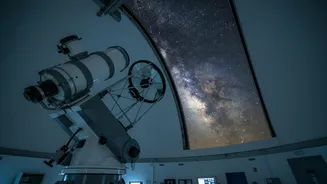
The backbone of this search is a network of automated survey telescopes. Projects like the Catalina Sky Survey (CSS) in Arizona, and the Panoramic Survey Telescope and Rapid Response System (Pan-STARRS) in Hawaii, are leaders in this field. A key player is the Asteroid Terrestrial-impact Last Alert System (ATLAS), funded by NASA and operated by the University of Hawaii. ATLAS uses multiple telescopes in Hawaii, Chile, and South Africa to scan the entire observable sky every 24 hours. This geographic spread ensures continuous coverage, resilience to bad weather, and a view of the southern sky that's invisible from the Northern Hemisphere. These aren't necessarily the largest telescopes, but they are designed for speed and width, able to image vast swathes of the sky in a single exposure.
Capturing a Ghostly Dance
The fundamental method for finding an asteroid hasn't changed much since the 19th century: look for the thing that moves against the background of stationary stars. Today, however, the process is highly automated. A survey telescope like one in the ATLAS system points to a patch of sky and takes a series of short exposures, typically four times over the course of about an hour. The system then automatically moves to the next patch of sky and repeats the process. On a clear night, a single survey can take thousands of images, covering nearly the entire visible sky. Each image is a digital snapshot captured by massive charge-coupled device (CCD) cameras, similar to but far more powerful than the sensor in a digital camera. This flood of data is then fed into a powerful computer system for the next, most crucial step.
Software That Spots a Threat
This is where the true automation shines. Sophisticated software, like the Moving Object Processing System (MOPS) used by Pan-STARRS, takes over. The software digitally stacks the series of images taken of the same sky patch. Because the stars are so far away, they don't move relative to each other. An asteroid, being much closer, will appear as a faint dot of light that has shifted its position from one image to the next. The software is designed to detect these moving points of light. It then checks the discovery against a massive database of all known objects, maintained by the Minor Planet Center (MPC). If there's no match, the object is flagged as a new candidate. This whole process, from image capture to potential detection, can happen in minutes.
From Detection to Orbit
A single detection isn't enough. To know if an asteroid is a threat, scientists need to determine its orbit. When a survey flags a new potential NEO, the information is immediately posted online for other astronomers around the world to see. This global community, including both professional and amateur observers, then points their own telescopes at the object to gather more data points. Each new observation helps refine the object's path. With enough data over several nights or weeks, computers can calculate a precise orbit and project its path far into the future. This allows scientists to determine if the asteroid will have any close approaches to Earth and assess any potential impact risk, thankfully, none of the 40,000 known NEAs pose a significant threat for the foreseeable future.