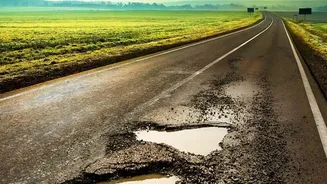







The Annual Pothole Problem
For millions of Indians, the end of the monsoon season signals the start of a different kind of challenge: navigating a landscape of damaged roads. The constant exposure to heavy rain weakens the binding agents in conventional asphalt, leading to cracks,
potholes, and widespread deterioration. This isn't just an inconvenience; it contributes to significant economic costs through vehicle damage, increased fuel consumption, and logistical delays. Furthermore, potholes are a serious safety hazard, responsible for a large number of road accidents and fatalities across the country each year. The cycle of annual damage followed by costly and disruptive patchwork repairs has become an accepted, if unwelcome, part of life.
Enter Self-Healing Asphalt
Imagine a road that can autonomously repair its own minor cracks before they grow into major problems. This is the promise of self-healing asphalt, a revolutionary approach to pavement engineering. Instead of being a passive material that simply degrades over time, this smart asphalt contains agents that actively work to mend damage. The concept involves embedding microscopic capsules or special materials within the asphalt mix. When a micro-crack forms due to stress from traffic or weather, it ruptures these capsules, releasing a healing agent that seals the fissure, effectively stopping the damage in its tracks. This technology aims to dramatically extend the lifespan of roads and reduce the constant need for maintenance.
The Science of Bio-Binders
The "bio-engineered binders" mentioned in the headline are at the heart of this innovation. One of the most promising methods involves using microcapsules filled with a rejuvenating oil, often derived from biological sources like biomass waste or algae. This bio-oil restores the chemical balance in aged bitumen, the glue that holds asphalt together, softening it just enough to flow into and seal cracks. When a crack appears, it breaks open the tiny capsules, and the released oil works its magic. Indian research institutions like IITs are actively experimenting with bio-bitumen and polymer-modified variants specifically designed to withstand the country's tropical climate and heavy traffic loads, showing a commitment to tailoring this global technology for local needs. Another approach involves using conductive materials like steel fibres in the asphalt mix, which can be heated by an induction machine to melt the surrounding bitumen and seal gaps.
Benefits Beyond a Smoother Ride
The advantages of self-healing roads go far beyond driver convenience. By significantly extending a pavement's service life—potentially by 35-40%—this technology promises massive long-term cost savings for governments and taxpayers. Fewer repairs mean less time spent closing lanes, leading to reduced traffic congestion and the associated economic drag. There is a powerful environmental argument as well. By making roads last longer, we reduce the need for quarrying new aggregates and producing new asphalt, a carbon-intensive process. This aligns perfectly with national infrastructure goals, such as the Bharatmala Pariyojana and Gati Shakti missions, which focus not just on building more roads, but building better, more sustainable ones.
The Road Ahead
While the technology is incredibly promising, widespread adoption still faces hurdles. The initial installation cost of self-healing asphalt can be higher than traditional mixes, though this is often offset by dramatically lower lifecycle maintenance costs. Researchers are working to develop more cost-effective and scalable production methods to make the technology viable for India's vast road network. Ensuring these advanced materials can withstand the extreme weather conditions and heavy axle loads common on Indian highways is another critical area of ongoing research. The National Highways Authority of India (NHAI) is already exploring these technologies, signaling a strong official interest in finding a lasting solution to the nation's pothole problem.