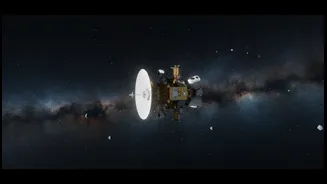




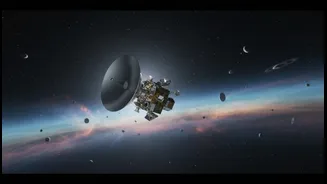


A Pioneer's Second Act
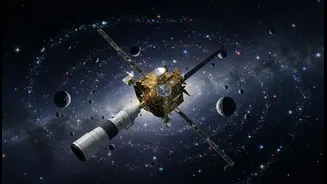
Launched in 2006, New Horizons etched its name in history with the first-ever exploration of the Pluto system in 2015, followed by a visit to the bizarre, snowman-shaped object Arrokoth in 2019. These encounters gave humanity its first close-up look at the frozen
worlds in the Kuiper Belt, a vast donut-shaped ring of icy bodies beyond Neptune. After these landmark achievements, the spacecraft has continued its journey, speeding away from the Sun at nearly 50,000 kilometres per hour. In late June 2026, after a 321-day hibernation to conserve power, mission controllers confirmed the probe had woken up and was in good health. But with no more close flybys currently planned, its new purpose is to serve as a unique deep-space observatory. Its location, far from Earth, provides a vantage point no other active mission can offer.
The Challenge of Finding Needles in a Haystack
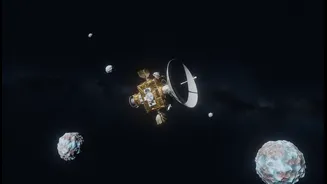
The Kuiper Belt is a scientific treasure trove, holding pristine relics from the formation of our solar system 4.6 billion years ago. But studying Kuiper Belt Objects (KBOs) is incredibly difficult. They are extremely small, incredibly dim, and located billions of miles away. Spotting them from Earth, even with powerful instruments like the Hubble Space Telescope or the Subaru Telescope in Hawaii, is like trying to find a piece of charcoal in the dark from across a country. Even after one is detected, figuring out its exact location, orbit, and size is a major challenge. Without precise data, it's hard for scientists to confirm whether an object is a scientifically interesting target for further study, or for a potential future spacecraft visit. This is where New Horizons' new role becomes critical.
Cosmic Teamwork: The Power of Parallax
The technique New Horizons uses is called parallax. It’s a simple concept you can test right now: hold your finger out at arm's length and look at it first with one eye closed, then the other. Your finger will appear to jump back and forth against the background. This apparent shift is parallax, and it happens because your eyes are seeing your finger from two slightly different angles. Astronomers use the same principle to measure distances to stars, using observations taken six months apart when Earth is on opposite sides of the Sun. But New Horizons provides a baseline not of millions, but billions of miles. By having a telescope on Earth and the camera on New Horizons observe the same KBO at the same time, scientists get two distinct views of the object against the backdrop of distant stars.
From Blurry Blobs to Validated Targets
Combining the two images allows astronomers to create a 3D view and calculate the KBO's distance and position with unprecedented accuracy. An object that was just a faint, uncertain smudge of light can be “validated” — its orbit confirmed and its properties better understood. This technique was famously demonstrated in 2020 when New Horizons was used to measure the parallax of nearby stars like Proxima Centauri and Wolf 359, creating a 3D image of their positions. The same principle is now being applied to KBOs. This validation is crucial for a few reasons. It helps scientists build a more accurate map of the outer solar system. It also allows the mission team to identify potential new targets for a future flyby, should NASA approve an extended mission. The search for a new destination relies on ground-based telescopes finding candidates, and New Horizons helps confirm if they are truly within reach.